The Jakarta Post
Please Update your browser
Your browser is out of date, and may not be compatible with our website. A list of the most popular web browsers can be found below.
Just click on the icons to get to the download page.


Popular Reads
Top Results
No results found. Please check your search term and try again
Can't find what you're looking for?
View all search results
Popular Reads
Top Results
No results found. Please check your search term and try again
Can't find what you're looking for?
View all search resultsAt UN, China denounces Japan and EU over South China Sea remarks
Japan and the European Union express concern over South China Sea tensions at UN Security Council maritime security forum, attracting criticism from China.
Change text size
Gift Premium Articles
to Anyone
Share the best of The Jakarta Post with friends, family, or colleagues. As a subscriber, you can gift 3 to 5 articles each month that anyone can read—no subscription needed!
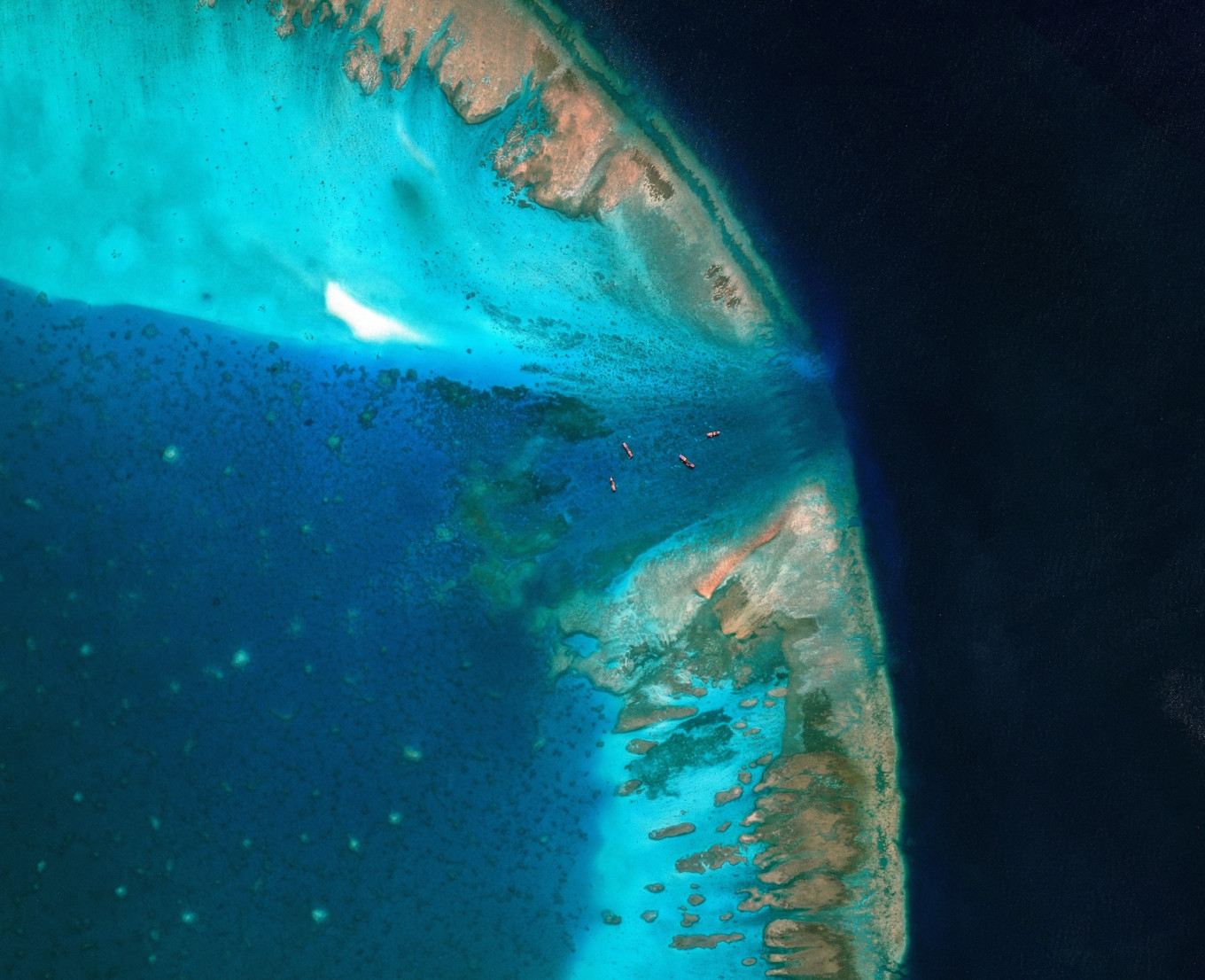 A satellite image shows fishing vessels blocked by a floating barrier at the entrance to the disputed Scarborough Shoal, in this file photo taken in the South China Sea on April 11, 2026. (Vantor via Reuters/handout)
C
hina denounced remarks by Japan and the European Union about the South China Sea at a United Nations Security Council meeting on Monday and accused Tokyo of provocative behavior in the Taiwan Strait and planning military expansion.
Ayano Kunimitsu, a Japanese vice foreign minister, told the Council meeting on maritime security in New York that Tokyo was seriously concerned about the situation in the East China and South China Seas and reiterated Japan's opposition to any attempt to change the status quo by force and obstruction of freedom of navigation and overflight.
Stavros Lambrinidis, head of the EU delegation to the United Nations, also highlighted South China Sea tensions, saying they hindered a critical shipping route and challenged the rules-based international order.
Neither mentioned China – which claims most of the South China Sea and disputes territory with Japan and in the East China Sea – by name.
China's deputy UN ambassador Sun Lei called the Japanese remarks "unwarranted," saying they "completely confound black and white." He added that the EU representative should "refrain from issuing unsubstantiated and irresponsible remarks on the South China Sea issue".
"In reality, the situation in the East and South China Seas remains stable overall and the South China Sea stands as one of the freest shipping lanes in the world," Sun said.
He accused Japan of recently sending vessels "to flex their muscles and deliberately provoke tensions in the Taiwan Strait," saying this sent a "gravely erroneous signal" to separatists in Taiwan, a democratically governed island China claims as its own.
Sun also referred to "erroneous remarks" on Taiwan by Japanese Prime Minister Sanae Takaichi last year, saying these "have dealt a severe blow to China-Japan relations".
Ties between Japan and China sank to their worst level in years after Takaichi said in November that a hypothetical Chinese attack on Taiwan could bring about a Japanese military response.
Sun charged that "right-wing forces are steering Japan's security policy towards an offensive and expansionist posture" and that 80 years after World War Two, "a new militarism is resurging in Japan".
He said Japan's relaxation of restrictions on the export of lethal weapons, its deployment of offensive missiles, and increased military spending "laid bare" Japan's intention "to pave the way for military expansion".
Japanese destroyer JS Ikazuchi transited the Taiwan Strait this month, a move China called "a deliberate provocation".
China has embarked on a massive expansion of its armed forces in recent years, militarized disputed reefs in the South China Sea, and engaged in repeated large-scale military exercises around Taiwan, sparking concern among countries across the Asia-Pacific region and beyond.
Late Monday, Taiwan's defense ministry said a Chinese destroyer and a frigate had entered waters to the southwest of the Penghu islands, home to major naval and air bases and close to the Taiwan side of the strait.