The Jakarta Post
Please Update your browser
Your browser is out of date, and may not be compatible with our website. A list of the most popular web browsers can be found below.
Just click on the icons to get to the download page.


Popular Reads
Top Results
No results found. Please check your search term and try again
Can't find what you're looking for?
View all search results
Popular Reads
Top Results
No results found. Please check your search term and try again
Can't find what you're looking for?
View all search resultsPartners vie for ASEAN trust as global divisions deepen
As top diplomats of ASEAN member states met with their key partners in Manila on the second day of the bloc’s Foreign Ministers Meeting, Indonesia calls for ‘real benefits’ in partnership beyond ceremonial engagements.
Change text size
Gift Premium Articles
to Anyone
Share the best of The Jakarta Post with friends, family, or colleagues. As a subscriber, you can gift 3 to 5 articles each month that anyone can read—no subscription needed!
 Set as preferred source
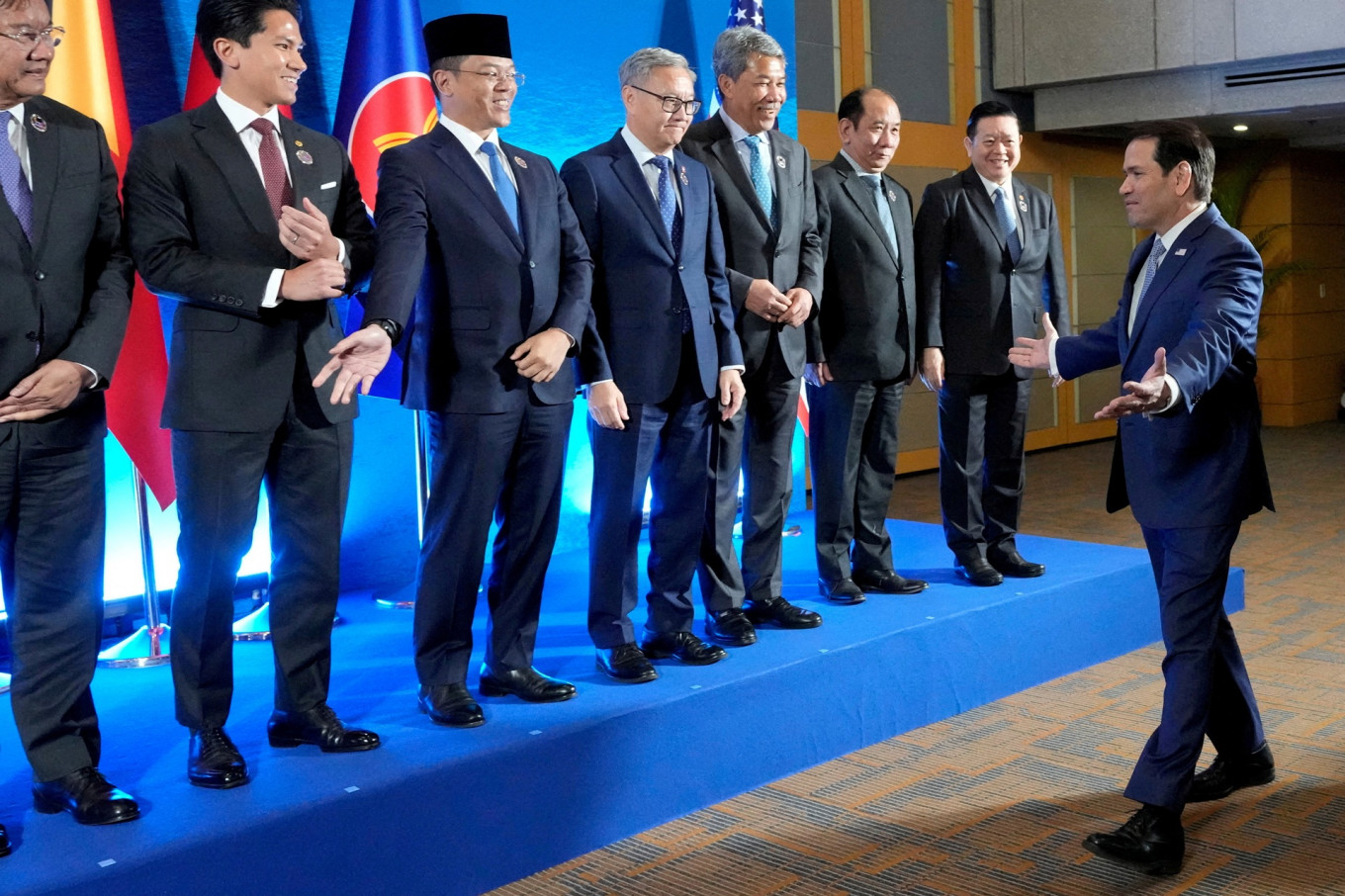 United States Secretary of State Marco Rubio (right) gestures as he arrives for a group photo session, while (from left to right) Cambodia's Foreign Minister Prak Sokhonn, Brunei's Foreign Minister Prince Abdul Maseen Bolkiah, Foreign Minister Sugiono, Laos Foreign Minister Thongsavanh Phomvihane, Malaysian Foreign Minister Mohamad Hasan, Myanmar's Permanent Secretary of the Ministry of Foreign Affairs Hau Khan Sum and ASEAN Secretary-General Kao Kim Hourn react during the ASEAN Post Ministerial Conference on July 22 with the United States on the sidelines of the ASEAN Foreign Ministers' Meeting (AMM) in Manila, the Philippines. (Reuters/Pool/Aaron Favila)
A
SEAN’s key partners have converged in the Philippines to present their case as trusted allies, seeking to deepen their ties with the increasingly coveted Southeast Asia as the bloc grappled with mounting geopolitical tensions and pressures on multiple fronts.
Top envoys from ASEAN’s 11 dialogue partners, including major powers China, Russia and the United States, gathered in Manila on Wednesday, the second day of the 59th ASEAN Foreign Ministers’ Meeting (AMM) that has been focusing on forging common positions on the region’s most pressing political and economic challenges.
Among the first ASEAN agenda for the day were talks with US Secretary of State Marco Rubio, who assured the bloc that Washington “100 percent” remained with them. He also called ASEAN the US’ primary mechanism for engaging a region that held “the future and story of the 21st century” for its strategic importance.
Turning quickly to one of ASEAN’s most pressing concerns, Rubio addressed the unabating US-Israel war against Iran that has cast a heavy shadow over the region in the past few months.
At the talks, Rubio portrayed Washington as a constructive actor, saying the US had been open-minded and willing to negotiate, while arguing that Iran’s failure to keep their commitments had prolonged the conflict.
“The US remains open and willing to engage [...] as long as the commitments made are kept. And when those commitments are not kept, [there] will be consequences,” Rubio said.