The Jakarta Post
Please Update your browser
Your browser is out of date, and may not be compatible with our website. A list of the most popular web browsers can be found below.
Just click on the icons to get to the download page.


Popular Reads
Top Results
No results found. Please check your search term and try again
Can't find what you're looking for?
View all search results
Popular Reads
Top Results
No results found. Please check your search term and try again
Can't find what you're looking for?
View all search resultsMusk dealt blow over Grok deepfakes, but regulatory fight far from over
The climb-down by Musk, who initially laughed off the trend, highlights the difficulty of policing AI tools that make it cheap and easy to create explicit content. It is the latest clash between Europe and Musk, following rows over election interference, content moderation and free speech.
Change text size
Gift Premium Articles
to Anyone
Share the best of The Jakarta Post with friends, family, or colleagues. As a subscriber, you can gift 3 to 5 articles each month that anyone can read—no subscription needed!
 Set as preferred source
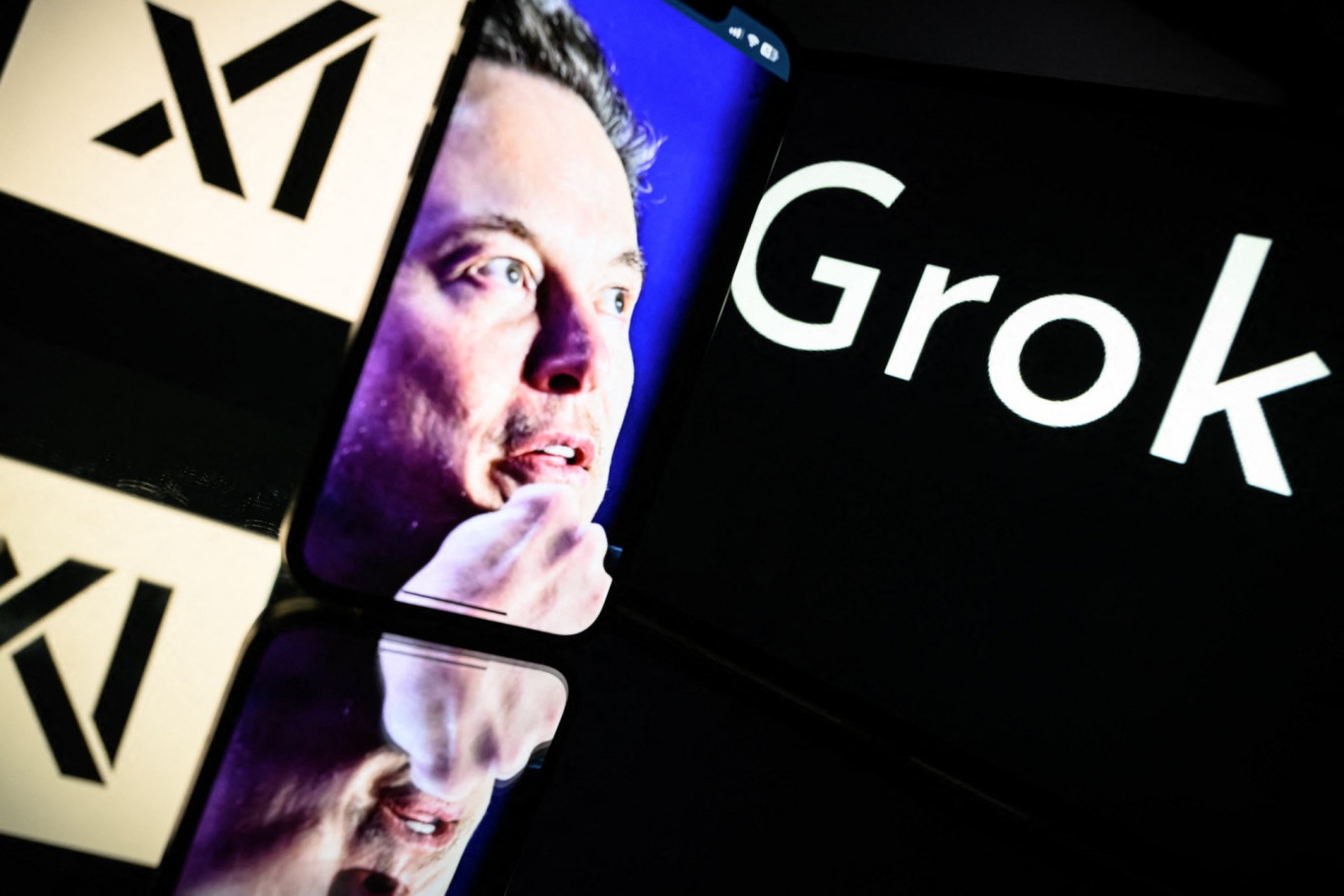 Screens display the logo of Grok, a generative artificial intelligence chatbot developed by xAI, the American company specializing in artificial intelligence and it's founder South African businessman Elon Musk in Toulouse, France on Jan. 13, 2025. (AFP/Lionel Bonaventure)
E
lon Musk's Grok chatbot is testing Europe's ability to clamp down on deepfakes and digital undressing of images online, even after regulators scored a rare win by forcing Musk's xAI to curb the creation of sexualized images.
xAI said late on Wednesday it had restricted image editing for Grok AI users after the chatbot churned out thousands of sexualized images of women and minors that alarmed global regulators.
The climb-down by Musk, who initially laughed off the trend, highlights the difficulty of policing AI tools that make it cheap and easy to create explicit content. It is the latest clash between Europe and Musk, following rows over election interference, content moderation and free speech.
Many regulators are still scrambling to develop laws and rules to govern AI, with question marks over what constitutes nudity, how to define consent, and who bears responsibility: the user or the platform.
"It's really a grey zone with regards to the creation of the nude images," Ängla Pändel, a Stockholm-based data protection and privacy lawyer with Mannheimer Swartling, told Reuters.
British regulator Ofcom, one of the most vocal on the issue, welcomed the move by Musk, but said its investigation into xAI over the Grok images would continue.

"Our formal investigation remains ongoing," a spokesperson said. "We are working round the clock to progress this and get answers into what went wrong and what's being done to fix it."
Earlier this month, Grok created hyper-realistic images of women on X manipulated to look like they were in tiny bikinis, degrading poses or even covered in bruises. Some minors were digitally stripped down to swimwear.
Until Wednesday, Reuters found the chatbot still produced sexualized images privately on demand. That appeared to have been curbed at least in certain geographies on Thursday.
Musk's xAI said it was blocking users from generating images of people in skimpy attire in "jurisdictions where it's illegal". It did not identify those jurisdictions.
In Malaysia and Indonesia the government has imposed temporary bans on Grok, while EU and UK regulators called the images unlawful. The UK, France and Italy launched probes, but faced calls for tougher action.
"Stronger enforcement under the Digital Services Act (DSA) is needed to stop apps and platforms that sexualise or nudify women and children," said Christian Democrat MEP Nina Carberry, who called the latest move a "positive step".
A European Commission spokesperson said that if the Grok changes were not effective, the Commission would still use the full enforcement toolbox of the EU's DSA against the platform.
The UK's Online Safety Act makes the sharing of intimate images without consent, including AI-generated deepfakes, a 'priority offence', said Alexander Brown, a UK-based data protection lawyer at Simmons & Simmons.
"This means X must take proactive, proportionate steps to prevent such content from appearing on its platform and to swiftly remove it when detected," he said.
Britain's regulator can fine a company up to 10% of revenue in the most serious cases of non-compliance or ask a court to require internet service providers to block the site.
For individuals, taking platforms to court is "a really difficult and heavy process,” said Anders Bergsten, a lawyer at Mannheimer Swartling, citing the emotional toll on victims.
Deepfakes have existed for years, well before the advent of the AI apps, though they were largely confined to the darker corners of the web. The publishing power of X gives Grok unprecedented reach.
"The frictionless publishing capability enables the deepfakes to spread at scale," said U.S.-based lawyer Carrie Goldberg, who works with cyber harassment victims.
Laws in Britain and Sweden make the non-consensual sharing of nude images illegal. Britain is widening the law to include the making of such images.
Under the DSA, suspending a service is considered a last resort. The EU AI Act also does not have any provision for nude images of adults, only transparency obligations for deepfakes, experts said.
British Prime Minister Keir Starmer welcomed X's move on Thursday but warned: "Free speech is not the freedom to violate consent. Young women's images are not public property, and their safety is not up for debate."
"If we need to strengthen existing laws further, we are prepared to do that."