The Jakarta Post
Please Update your browser
Your browser is out of date, and may not be compatible with our website. A list of the most popular web browsers can be found below.
Just click on the icons to get to the download page.


Popular Reads
Top Results
No results found. Please check your search term and try again
Can't find what you're looking for?
View all search results
Popular Reads
Top Results
No results found. Please check your search term and try again
Can't find what you're looking for?
View all search resultsDeepSeek unveils new AI model tailored for Huawei chips
The close collaboration with Huawei on the new model, the V4, contrasts with DeepSeek's past reliance on Nvidia's AI chips.
Change text size
Gift Premium Articles
to Anyone
Share the best of The Jakarta Post with friends, family, or colleagues. As a subscriber, you can gift 3 to 5 articles each month that anyone can read—no subscription needed!
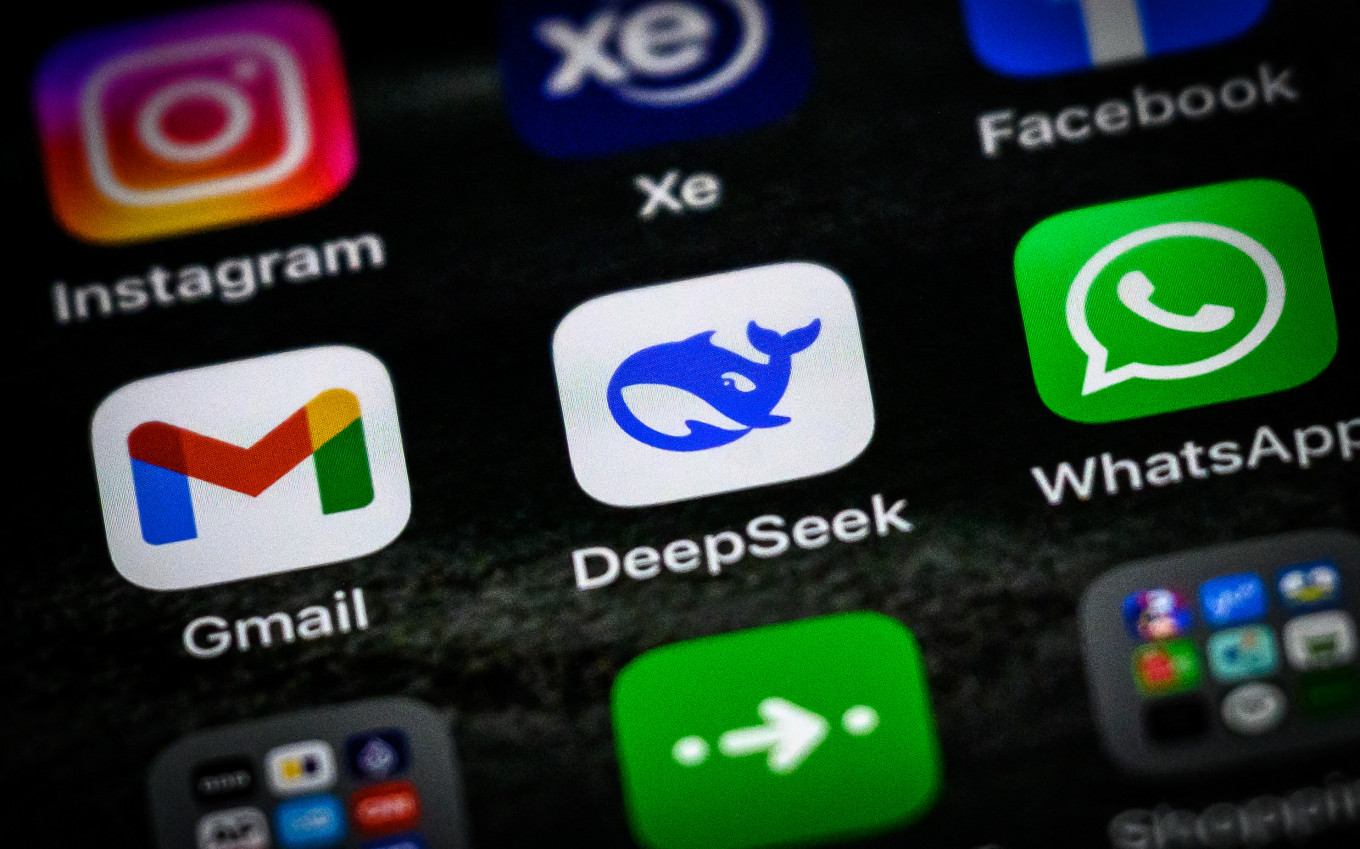 This photo illustration shows the DeepSeek app on a mobile phone in Hong Kong on Jan. 28, 2025. (AFP/Mladen Antonov)
D
eepSeek, the Chinese startup whose low-cost AI model stunned the world last year, launched on Friday a preview of a highly awaited new model adapted for Huawei chip technology, underlining China's growing autonomy in the sector.
The Pro version of the new model outperforms other open-source models in world-knowledge benchmarks, trailing only Google's closed-source Gemini-Pro-3.1, DeepSeek said.
The close collaboration with Huawei on the new model, the V4, contrasts with DeepSeek's past reliance on Nvidia's AI chips. Huawei said its chips were used in some of the V4's training process.
"This is a big deal for China's AI industry," said He Hui, director of semiconductor research at consultancy Omdia.
"Huawei's Ascend chips are the country's best homegrown alternative to Nvidia, and supporting DeepSeek V4 shows that top Chinese AI models can now run on Chinese hardware."
Most leading AI models are trained and run on chips made by Nvidia. And DeepSeek's pivot to Huawei underscores concerns raised by Nvidia CEO Jensen Huang that the US firm risks losing its developer ecosystem in China due to US export controls and Beijing's push for self-sufficiency.

"The day that DeepSeek comes out on Huawei first, that is a horrible outcome for our nation," Huang said on a podcast this month.
The V4 is the fastest model to trend at the top spot on Hugging Face, a popular developer forum for sharing and running machine learning models, said Lewis Tunstall, a machine learning engineer at Hugging Face.
It is good at handling extremely long and complex text tasks, and it does so much more cheaply than competing top models, but has some limitations. For instance, it doesn't support multiple modalities like images and video, Tunstall said.
Close collaboration
DeepSeek has drawn criticism from Washington and US rivals that its success owes much to the improper use of American know-how.
For its part, DeepSeek has acknowledged the use of Nvidia chips but has not said whether those chips were subject to export bans. It has also said it has not intentionally used synthetic data generated by OpenAI.
Friday's launch comes a day after the White House accused China of stealing US AI labs' intellectual property on an industrial scale, and ahead of a visit by US President Donald Trump to Beijing next month to meet with China's leader, Xi Jinping.
The Trump administration in January gave the green light for Nvidia's powerful H200 chips to be sold in China but sources have said that shipments have been stymied by disagreements over the terms of the sales both in China and the US
Chinese chipmakers rallied on expectations for wider use of homegrown chips, with Huahong Semiconductor and SMIC surging 15 percent and 10 percent, respectively.
Nvidia shares were up as well thanks to Intel forecasting surprisingly strong revenue and profit, reinforcing confidence that the AI boom was showing no signs of slowing down.
Many rivals
Many Western and some Asian governments have banned their institutions and officials from using DeepSeek, citing data privacy concerns. Nevertheless, DeepSeek's models have consistently been among the most used on international platforms that host open-source models.
In China, despite rocketing to national champion status a year ago, its lead has evaporated amid a slew of competitive offerings from domestic rivals. V4's release sent shares of rivals tumbling, with Zhipu AI and MiniMax both losing 9 percent.
DeepSeek said on Friday that the V4 would be particularly suited to AI agent work, which can execute more complex tasks than chatbots but needs more computing power.
Just how successful it will be remains to be seen.
"My initial view is that DeepSeek V4 preview looks significant, but I'd be cautious about taking the benchmark headline at face value until there are independent evaluations and more real-world developer testing," said Daniel Dewhurst, an AI engineer who tested V4 after its release.
Notably though, the V4 shows that open models that people can use and run themselves appear to be further closing the gap with closed models, especially around cost, long context and coding, he said.
It can process over one million tokens - putting it on par with the context windows of OpenAI's GPT-5.4 and Anthropic's Claude Opus 4.6, but only requires a fraction of the compute to do so.
The V4 also comes in a lower-cost Flash version. Preview versions allow the company to incorporate real-world feedback and make changes ahead of a final product launch. DeepSeek did not provide a timeline for when the model is expected to be finalized.
Owned by China's High-Flyer Capital Management, DeepSeek is aiming to raise funds at a valuation exceeding US$20 billion, according to a report by The Information this month, which also said that tech giants Alibaba and Tencent were in discussions to take stakes.