The Jakarta Post
Please Update your browser
Your browser is out of date, and may not be compatible with our website. A list of the most popular web browsers can be found below.
Just click on the icons to get to the download page.


Popular Reads
Top Results
No results found. Please check your search term and try again
Can't find what you're looking for?
View all search results
Popular Reads
Top Results
No results found. Please check your search term and try again
Can't find what you're looking for?
View all search resultsMaintaining the competitiveness of the national plywood industry
Indonesia’s plywood industry, which accounts for a significant share of exports, has further growth potential but also faces numerous challenges. Enhancing the competitiveness of domestic producers requires integrated strategic measures.
Change text size
Gift Premium Articles
to Anyone
Share the best of The Jakarta Post with friends, family, or colleagues. As a subscriber, you can gift 3 to 5 articles each month that anyone can read—no subscription needed!
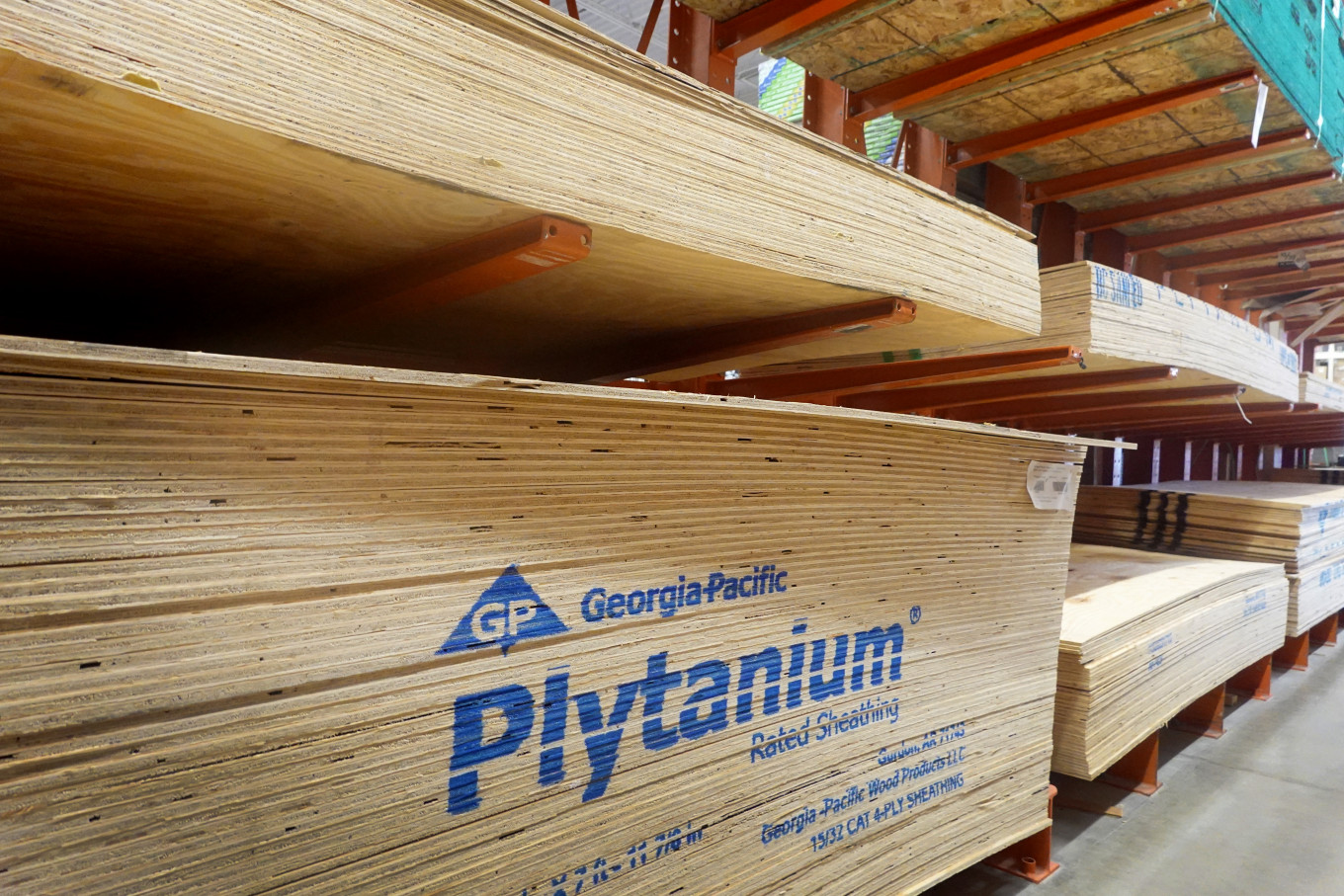 Plywood is offered for sale at a home improvement store on June 21, 2023 in Illinois, the United States. (Getty Images via AFP/Scott Olson)
A
mid global challenges, Indonesia's non-oil and gas exports still grew by 7.7 percent in 2025, with one of the key contributors being plywood exports (Harmonized System Code 4412). Plywood is an engineered wood product made up of multiple thin layers of wood veneer. These layers are glued together, with the wood grain of adjacent layers rotated at right angles to one another. Plywood products are widely used in interior design and furniture manufacturing.
From 2021 to 2025, plywood exports averaged US$2 billion, making Indonesia the world's second-largest plywood exporter, while global plywood imports reached $17.3 billion in 2025. Furthermore, plywood is Indonesia's largest export among all wood-product categories. The United States is Indonesia’s primary export destination, accounting for 29.4 percent of total national plywood exports, followed by Japan at 26.3 percent, a market in which Indonesia is the largest exporter. In addition, Indonesia possesses one of the largest tropical forest areas in the world with a remarkable diversity of commercial timber species. This performance demonstrates the enormous potential of Indonesia's plywood industry.
Despite this great potential, Indonesia’s plywood industry faces numerous challenges. One of the most significant is the growing global demand for wood products that are certified as legal and sustainable. One of the latest regulations introduced by the European Union is the EU Deforestation Regulation (EUDR), a policy that requires certain commodities entering the European market to be proven deforestation-free, legally produced and fully traceable to their origin. Similar regulations have been implemented in other major export destinations for Indonesian plywood, including the United States, Japan and South Korea. Increasingly intense competition from other plywood-producing countries, such as China, Vietnam and Brazil, is also placing pressure on Indonesia's position in the global market.
In addition, the Indonesian plywood industry faces the challenge of raw-material scarcity, which is gradually eroding its competitiveness. Extensive exploitation of natural forests has depleted the stock of high-quality tropical timber, while the moratorium on primary forests and the reduction of annual logging quotas have further limited the industry's ability to secure raw materials.
Safeguarding and enhancing the competitiveness of the national plywood industry requires integrated strategic measures. First, the government should implement the Timber Legality Verification System (SVLK) across all plywood producers in Indonesia. It should ensure that obtaining SVLK certification is accessible, efficient and affordable for all industry players, particularly small and medium enterprises (SMEs). High certification costs, lengthy verification processes and the limited availability of auditors in remote areas often become obstacles that exclude small businesses from formal export supply chains. Therefore, the government needs to simplify administrative procedures, provide subsidies or certification incentives for SMEs and strengthen the reliability of the SILK information system, so that the issuance of legality documents is not hindered by technical disruptions. Moreover, mentoring programs and educational initiatives on the importance of timber legality should be intensified, so that all business actors understand and are able to comply with documentation requirements.
Second, the government and plywood industry players must collaborate to explore alternative export destinations to reduce dependence on traditional markets. Regions with strong growth potential include the Middle East, which is currently undertaking large-scale construction projects; South Asia, with its large population and growing demand for housing, and the ASEAN region, which remains an underutilized market. Through strong synergy between the government and industry players, export-market diversification will not only strengthen the plywood industry's resilience against global market volatility but also create new and more sustainable growth opportunities.

Another important measure is accelerating the development of Industrial Plantation Forests (HTI) while optimizing the vast potential of community forests through the establishment of cooperatives and partnership schemes that aggregate timber volumes from small, scattered holdings. This approach can help ensure fair prices for timber producers while maintaining a stable supply of raw materials for the industry. In addition, the modernization of machinery and the adoption of precision peeling technology can improve production efficiency, enabling every log to be utilized to its maximum potential while allowing wood waste to be processed into value-added products.
Furthermore, all of these efforts must be supported by conducive government policies, including incentives for HTI investment, equitable allocation of raw materials across sectors, improvements in upstream logistics infrastructure and stronger enforcement against timber smuggling. Partnerships with global companies should also be strengthened to facilitate technology transfer and increase production capacity. Equally important is the promotion of research and innovation through collaboration among industry players, universities and research institutions to develop efficient technologies and alternative raw materials, thereby creating an integrated and sustainable plywood industry ecosystem.
In conclusion, these strategic measures should enhance the competitiveness of Indonesia's plywood industry amid increasingly intense global competition and more complex market demands. Strong and sustainable collaboration among the government, industry players and the wider community will ensure that the national plywood industry not only survives but also grows as one of the resilient, self-reliant, and highly competitive pillars of Indonesia's non-oil and gas exports on the global stage.
****
The writer is an industry and regional analyst at Bank Mandiri.