TheJakartaPost
Please Update your browser
Your browser is out of date, and may not be compatible with our website. A list of the most popular web browsers can be found below.
Just click on the icons to get to the download page.


Popular Reads
Top Results
No results found. Please check your search term and try again
Can't find what you're looking for?
View all search results
Popular Reads
Top Results
No results found. Please check your search term and try again
Can't find what you're looking for?
View all search resultsIdul Adha livestock farmers hit by falling demand as purchasing power weakens
The Institute for Demographic and Affluence Studies (IDEAS) estimates that the number of livestock purchased for sacrificial purposes has declined slightly nationwide, falling from 1.6 million animals last year to around 1.59 million this year.
Change text size
Gift Premium Articles
to Anyone
Share the best of The Jakarta Post with friends, family, or colleagues. As a subscriber, you can gift 3 to 5 articles each month that anyone can read—no subscription needed!
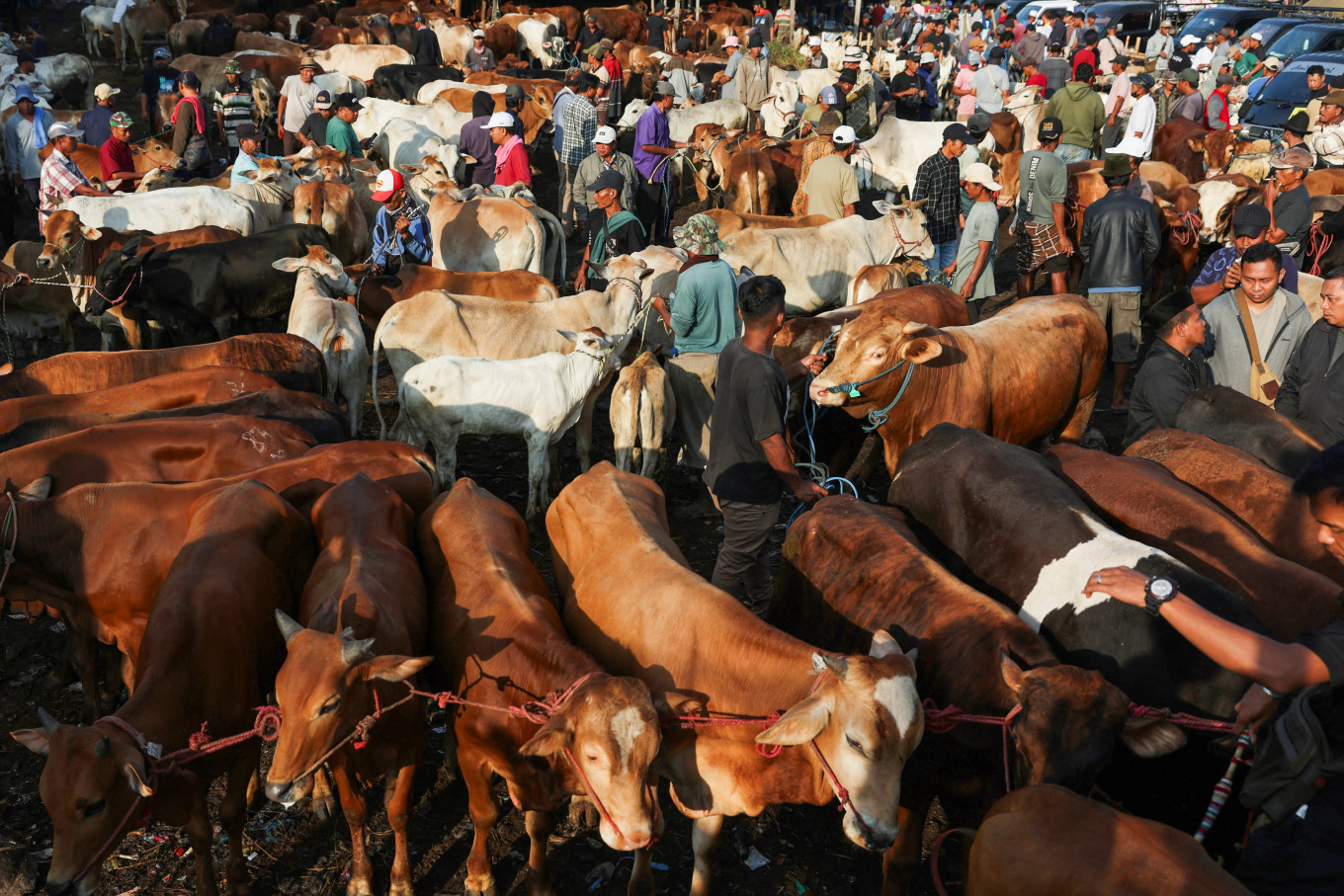 Traders sell cattle at a traditional livestock market, ahead of Idul Adha holiday, in Bogor, West Java, on May 21, 2026. (REUTERS/Ajeng Dinar Ulfiana)
L
ivestock farmers across several regions reported a significant drop in sales ahead of Wednesday’s Idul Adha holiday, with weakening consumer purchasing power and prolonged economic pressures curbing demand for sacrificial animals.
Dede, a goat farmer in East Jakarta, said his sales had plunged by as much as 60 percent compared with last year.
“I’m quite anxious. From two weeks ago until a day before Idul Adha, I’ve only sold 16 goats. By this point last year, I had sold 40,” Dede said on Tuesday, as quoted by CNN Indonesia.
The decline came despite Dede’s decision to stock only small- to medium-sized goats sourced from his hometown in Kuningan, West Java, which he priced between Rp 3 million (US$168.25) and Rp 3.8 million in an effort to match consumers’ tighter budgets.
“I understand that people are struggling economically, so this year I only brought smaller goats,” he said.
Dede said he hoped sales would improve in the final days before the holiday, as unsold livestock would force him to shoulder additional transportation costs to return the animals to his hometown.

“Hopefully I won’t have to spend too much money in sending the goats back to my village,” he added.
Farmer Najib, 54, traveled from his hometown in Mojokerto, East Java, to the Bali provincial capital of Denpasar, to sell goats ahead of the Idul Adha holiday, but said business was far slower than last year.
“Sales have declined significantly compared with last year, by around 40 percent. I’m suffering losses,” he said on Monday, as quoted by Detik.com.
The goats he sells are priced between Rp 2.5 million and Rp 5.5 million, depending on their size. Najib sources the animals from livestock traders and said profit margins were already very thin.
“The main problem is that purchase prices are already high, transportation costs are expensive because the distance is far, and there are fewer buyers this year,” he said.
“If the goats do not sell, I will be forced to raise them myself or sell them cheaply. Either way, I still bear the losses,” Najib added.
In Surabaya, East Java, livestock trader Pondra Irawan Pradita said sales had also dropped sharply compared with the same period last year.
“I have only sold 250 goats and 75 cattle so far. During the same period last year, I had sold 450 goats and 140 cattle,” he said on Sunday, as quoted by Tempo.co.
Pondra said he was trying to find creative ways to market his livestock amid the slowdown in sales, including promoting the animals through social media platforms such as Instagram and TikTok.
The Institute for Demographic and Affluence Studies (IDEAS) estimates that the number of livestock purchased for sacrificial purposes has declined slightly nationwide, falling from 1.6 million animals last year to around 1.59 million this year.
IDEAS reported that the total economic value generated by the Idul Adha livestock trade slipped from Rp 27.1 trillion last year to about Rp 26.8 trillion this year.
The institute also observed a notable change in consumer preferences. Fewer people are opting for large sacrificial animals, while more buyers are turning to smaller, lower-cost livestock as they adjust to tighter budgets.
“This finding suggests there is a shift in how the public performs Idul Adha sacrifices amid domestic economic pressure. People are still carrying out the sacrifice, but they are choosing more affordable options. This reflects weakening purchasing power due to rising food prices, higher living costs and increased livestock production costs in recent years,” said IDEAS researcher Tira Mutiara.
The director general of Islamic community guidance at the Religious Affairs Ministry, Abu Rokhmad, said the ministry expected a decline in the number of sacrificial animals this year amid mounting economic pressures.
He said rising inflation and higher food prices had pushed up basic household expenses, particularly for middle-income families, forcing many to reassess their spending, including for Idul Adha sacrifices.
“This year’s Idul Adha also falls just weeks ahead of the new academic year, prompting many families to prioritize education-related expenses for their children,” Abu said on Saturday.
Despite these financial pressures, he said many middle-class families continued to perform qurban (sacrifice), although an increasing number are opting for smaller and more affordable livestock.
“It reflects a collective sense of awareness and social responsibility to ensure that vulnerable communities continue to have access to protein and do not fall further into food insecurity amid difficult economic conditions,” he said. (nal)