TheJakartaPost
Please Update your browser
Your browser is out of date, and may not be compatible with our website. A list of the most popular web browsers can be found below.
Just click on the icons to get to the download page.


Popular Reads
Top Results
No results found. Please check your search term and try again
Can't find what you're looking for?
View all search results
Popular Reads
Top Results
No results found. Please check your search term and try again
Can't find what you're looking for?
View all search resultsCommentary: A humane way to expand Jakarta's green space after Kalijodo
Jakarta needs more green space for several reasons, not just because they currently account for only 10 percent of the cityâs territory
Change text size
Gift Premium Articles
to Anyone
Share the best of The Jakarta Post with friends, family, or colleagues. As a subscriber, you can gift 3 to 5 articles each month that anyone can read—no subscription needed!

J
akarta needs more green space for several reasons, not just because they currently account for only 10 percent of the city's territory. While the need is indisputable, the method for increasing green spaces has become the subject of debate following the recent inhumane eviction of Kalijodo residents.
More green space means more water-catchment area, cleaner air and more social interaction, thus improved wellbeing for residents from all socio-economic backgrounds, including the city's underclass.
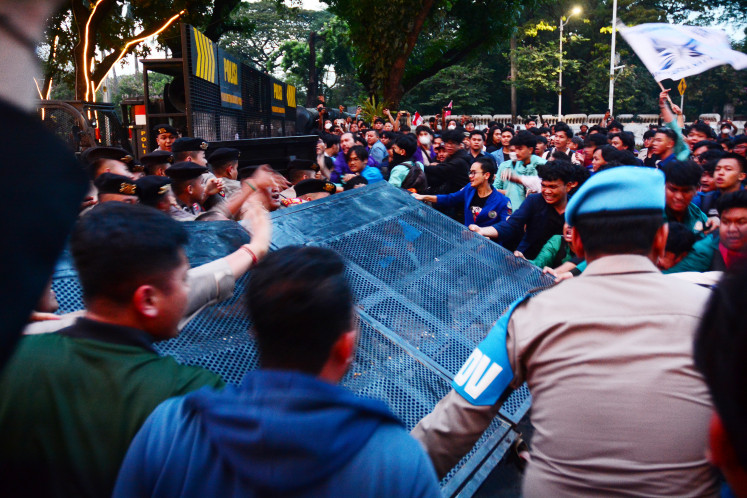
The Kalijodo eviction, in the name of 1.6 hectares (ha) of green space, has violated several international principles of involuntary resettlement, in particular the UN International Covenant on Economic, Social and Cultural Rights that Indonesia ratified in 2005. The covenant stipulates that forced evictions have to be a last resort and if they must be done the operation should meet several requirements to minimize violations of the right to housing, which the covenant seeks to protect.
Among the conditions are 'genuine consultation with those affected' and 'evictions should not result in individuals being rendered homeless or vulnerable to the violation of other human rights'.
The Kalijodo case obviously violated the covenant and while it was done for the wellbeing of people outside the historical red-light district, should we turn a blind eye to the fate of thousands of Kalijodo residents simply because they are 'prostitutes and thugs' and 'holding no Jakarta ID cards'?
Of the 3,052 people from 1,340 families that lived there, only about 220 are eligible for low-cost rental apartments (rusunawa). Some of the 220 residents told The Jakarta Post they had refused to take the apartments because taking them would have meant leaving their livelihood behind, or their children's school. The eviction took place in the middle of a school year, which will end in June.
Kalijodo is not the first Jakarta eviction to violate international standards.
The Jakarta Legal Aid Institute (LBH Jakarta) last week released a report that found 95 of 113 evictions conducted in 2015 involved no consultation with evictees. The report further shows that 72 evictions offered no solutions to the affected residents at all. From 32 cases in which relocations were provided, only 18 were deemed adequate.
The LBH Jakarta report also revealed that four of the evictions, which affected a total of 8,145 families and 6,283 businesses, were to make way for green space.
Many people have thrown support behind more evictions, stronger law enforcement equally against both poor people and rich people who occupy green space. It, however, is a mistake to assume there is a level playing field between the poor and the rich and try to uphold the law without taking into consideration the long history of spatial-planning violations in favor of large developers. Under such circumstances, what would happen is that Jakarta would expand its green spaces quickly but leave thousands of more people homeless and impoverished while the commercial buildings continued to stand on former parks.
Jakarta has experienced a rapid decrease in green space for decades, owing not only to mushrooming residential areas but also the rapid development of commercial space, including parts of the 320-ha Senayan area in Central Jakarta. The now Taman Ria Senayan was originally a green space, while Pluit city park in North Jakarta has been converted into Pluit Village, formerly Mega Mall Pluit.
Urban planner Elisa Sutanudjaja wrote in 2013 for rujak.org that Pluit Village stood on 22 ha of land where Tirta Loka Park was situated. The city transferred management of the land to PT Duta Wisata Loka under a 30-year build, operate and transfer scheme in 1995.
In 2010, then-governor Fauzi Bowo planned to change the 11-ha Taman Ria Senayan back into green space but failed when a Supreme Court verdict in 2012 handed the right to build a commercial facility on the land to developer PT Ariobimo Laguna Perkasa.
After Kalijodo, pressure has mounted on Jakarta Governor Basuki 'Ahok' Tjahaja Purnama to also enforce the law against commercial entities occupying green space, but he says his hands are tied because many of them hold land certificates.
The Senayan case shows his argument is not too far off the mark, but demonstrates that for the time being, for pragmatic reasons, to increase green space Ahok will only target the poor and defenseless such as sex workers and thugs.
Therefore, instead of supporting the city's discriminatory practices, the public should push for more creative, humane ways of expanding green space.
The Jakarta administration has to make an inventory of land transfer schemes like the case of Pluit Village and restore them as green areas when the contracts end. To make up for diminishing water-catchment areas, the administration has to enforce the 2012 gubernatorial decree on green buildings, which requires buildings to apply a rain harvesting system to reduce run-off and to have 'green roofs'.
Jakarta needs to hold more community center programs, like those held at child-friendly integrated public spaces (RPTRA), as they have contributed to more green spaces that serve as centers for social interaction without sacrificing the poor. And to promote clean air, Jakarta should get tougher on smokers and dirty vehicle emissions and plant more trees in existing spaces instead of evicting people.
This way, Jakartans can enjoy green spaces and a better city for all without having to sacrifice others so callously.