The Jakarta Post
Please Update your browser
Your browser is out of date, and may not be compatible with our website. A list of the most popular web browsers can be found below.
Just click on the icons to get to the download page.


Popular Reads
Top Results
No results found. Please check your search term and try again
Can't find what you're looking for?
View all search results
Popular Reads
Top Results
No results found. Please check your search term and try again
Can't find what you're looking for?
View all search resultsFrom strategic dependency to strategic diversification: The energy shock moment
Despite its resource endowment, Indonesia remains structurally dependent on imported fuel, particularly refined petroleum products sourced largely from regional hubs.
Change text size
Gift Premium Articles
to Anyone
Share the best of The Jakarta Post with friends, family, or colleagues. As a subscriber, you can gift 3 to 5 articles each month that anyone can read—no subscription needed!
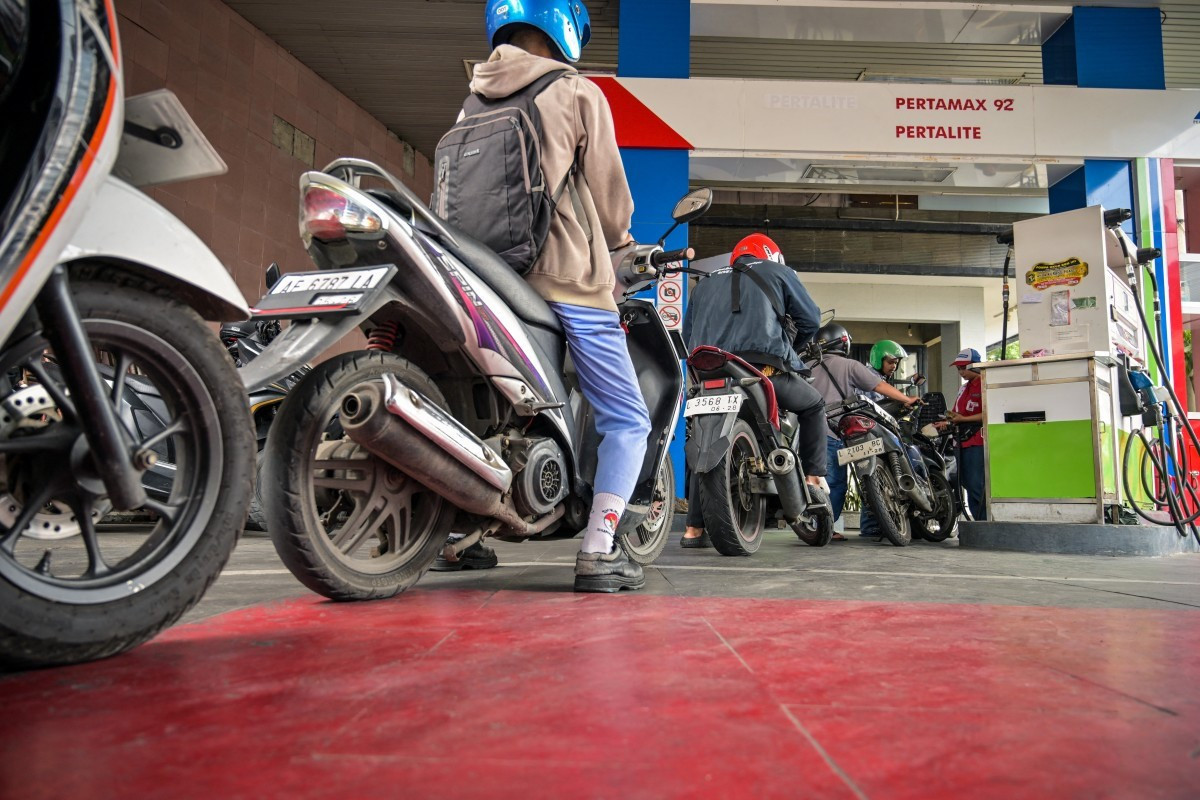 Motorcycle riders line up at a gas station on March 9 in Surabaya, East Java. (AFP/Juni Kriswanto)
T
he current energy shock triggered by the United States–Israeli war against Iran reveals that despite its resource endowment, Indonesia remains structurally dependent on imported fuel, particularly refined petroleum products sourced largely from regional hubs such as Singapore and Malaysia.
It may show that, as proven in various Indonesian neighboring countries, major geopolitical crises, especially one affecting global energy flows, could trigger cascading economic effects through fuel prices, transport costs and inflation.
For many analysts focusing on economic security, the current crisis is not an unforeseen disruption; it is a manifestation of risks that were empirically identified yet operationally unaddressed, underscoring the gap between identifying strategic dependencies and operationalizing policies to mitigate them. Although the crisis does not reveal a failure of foresight, it has already revealed various failures of policy translation. The risks were mapped, but the structural responses required to mitigate them might not be implemented in time.
For countries like Indonesia, as disruptions ripple through choke points such as the Strait of Hormuz, prevention is no longer possible. The policy logic must now shift from anticipation to resilience, across three interconnected fronts: moving dependencies to strategically diversifying supply, correcting domestic price signals in the market, and reshaping consumer behavior.
Diversification is not optional; it is time-sensitive. Once a crisis unfolds, switching suppliers, rerouting logistics or restructuring contracts becomes costly and constrained. Diversification delayed is diversification denied. Indonesia’s continued reliance on a narrow set of suppliers and routes has left it exposed to precisely the type of disruption that was anticipated but not sufficiently addressed.
However, the diversification logic must go beyond switching partners. The real risk lies in concentrated nodes within the system, whether choke points like Hormuz, refining hubs outside Indonesia or single-stage import structures such as refined fuel. This highlights the need for a more layered approach to diversification, one that includes not only who Indonesia trades with, but also how those supply chains are structured.

This means foreign policy, while too late as a preventive instrument, remains crucial as a tool to secure alternative sources of crude and liquefied natural gas beyond traditional Middle Eastern routes, negotiating government-to-government fallback arrangements and exploring swap or barter mechanisms that leverage Indonesia’s commodity strengths, particularly nickel or biofuel, to guarantee access to energy. Regional and multilateral platforms should also be used to discourage export restrictions and maintain open trade flows, even if institutional mechanisms remain limited.