TheJakartaPost
Please Update your browser
Your browser is out of date, and may not be compatible with our website. A list of the most popular web browsers can be found below.
Just click on the icons to get to the download page.


Popular Reads
Top Results
No results found. Please check your search term and try again
Can't find what you're looking for?
View all search results
Popular Reads
Top Results
No results found. Please check your search term and try again
Can't find what you're looking for?
View all search resultsShow or short of force?
Indonesia’s flashy new fighter jets look impressive, but recent wars prove that expensive planes are useless without a powerful, layered missile defense system to back them up.
Change text size
Gift Premium Articles
to Anyone
Share the best of The Jakarta Post with friends, family, or colleagues. As a subscriber, you can gift 3 to 5 articles each month that anyone can read—no subscription needed!
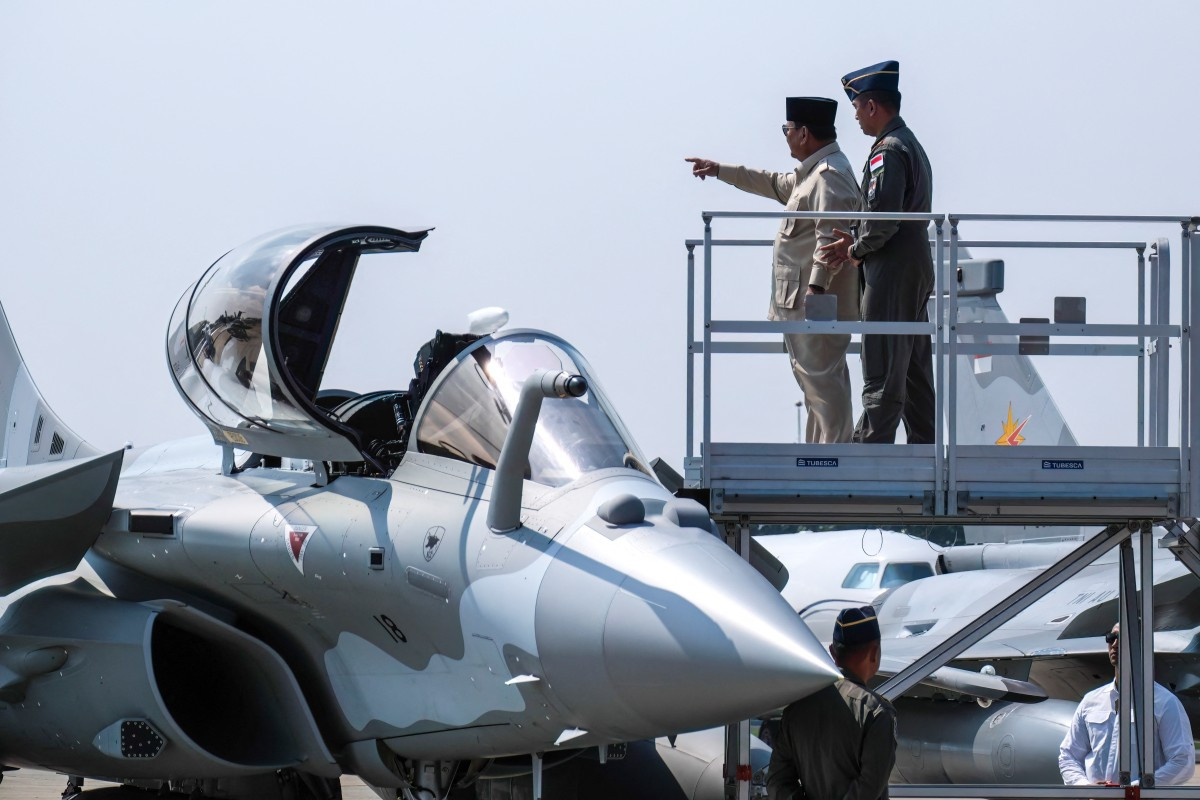 President Prabowo Subianto (2nd right) gestures as he looks inside the cockpit of a Rafale jet fighter during a ceremony on May 18 to hand over six new Rafale jet fighters, four Dassault Falcon 8X aircrafts and one Airbus A400M Atlas aircraft to the Indonesian Air Force at Halim Perdanakusuma Air Force Base in Jakarta. (AFP/Bay Ismoyo)
A
mid media fanfare, President Prabowo Subianto handed over to the Indonesian Military (TNI) last week the country’s latest aerospace acquisitions that included six French-made Dassault Rafale multirole fighters, four Falcon 8X strategic transport jets and two Airbus A400M Atlas transport aircraft.
It was a clear show of force for the Southeast Asian giant, which has gradually been beefing up its defense capability to protect its huge jurisdiction, along with valuable natural resources, from external threats. While the new military display appears modern and impressive, a closer look shows a big gap between the expensive new equipment Jakarta is buying and the deep, underlying weaknesses that put its air defense system at risk.
Buying the new Rafale fighter jets, 42 in total, is by all means a major upgrade for Indonesia, which currently relies on aging jets. Equipped with advanced Meteor missiles and HAMMER bombs, the Indonesian Air Force (TNI-AU) can now hit targets from much further away, making them far better at defending their airspace than they were with older planes.
At the same time, adding large Airbus A400M transport planes makes it much easier to move troops and supplies over the world’s largest archipelagic state, while also allowing jets to refuel mid-air. On the ground, new Thales Ground Master 403 radars will serve as an early warning system, helping to track areas that were previously blind spots.
However, these acquisitions arrive amid an intensifying great power rivalry in the highly contested Indo-Pacific, where friction between the United States and China places Indonesia directly on a geopolitical fault line. The country’s vast territory—spanning over 17,000 islands and vital maritime choke points like the Malacca and Lombok straits—demands an air defense net capable of sustained, high-intensity area denial.
Yet, Indonesia's defense spending remains chronically constrained, hovering below 0.8 percent of its GDP. This ratio lags significantly behind Southeast Asian peers like Singapore and Vietnam, leaving the Air Force struggling to fund the multi-layered air defense infrastructure required to protect its enormous sovereign airspace.

Beyond the celebrated procurement, the hardware display underscores Indonesia's persistent and dangerous reliance on foreign defense imports. Despite legislative mandates urging defense autarchy through local state-owned strategic firms like PT Dirgantara Indonesia or PT Pindad, TNI’s advanced platforms are entirely imported.