TheJakartaPost
Please Update your browser
Your browser is out of date, and may not be compatible with our website. A list of the most popular web browsers can be found below.
Just click on the icons to get to the download page.


Popular Reads
Top Results
No results found. Please check your search term and try again
Can't find what you're looking for?
View all search results
Popular Reads
Top Results
No results found. Please check your search term and try again
Can't find what you're looking for?
View all search resultsThe Pope should have gone further on AI
Pontiff has not gone far enough on the most consequential question: What should AI be designed to do?
Change text size
Gift Premium Articles
to Anyone
Share the best of The Jakarta Post with friends, family, or colleagues. As a subscriber, you can gift 3 to 5 articles each month that anyone can read—no subscription needed!
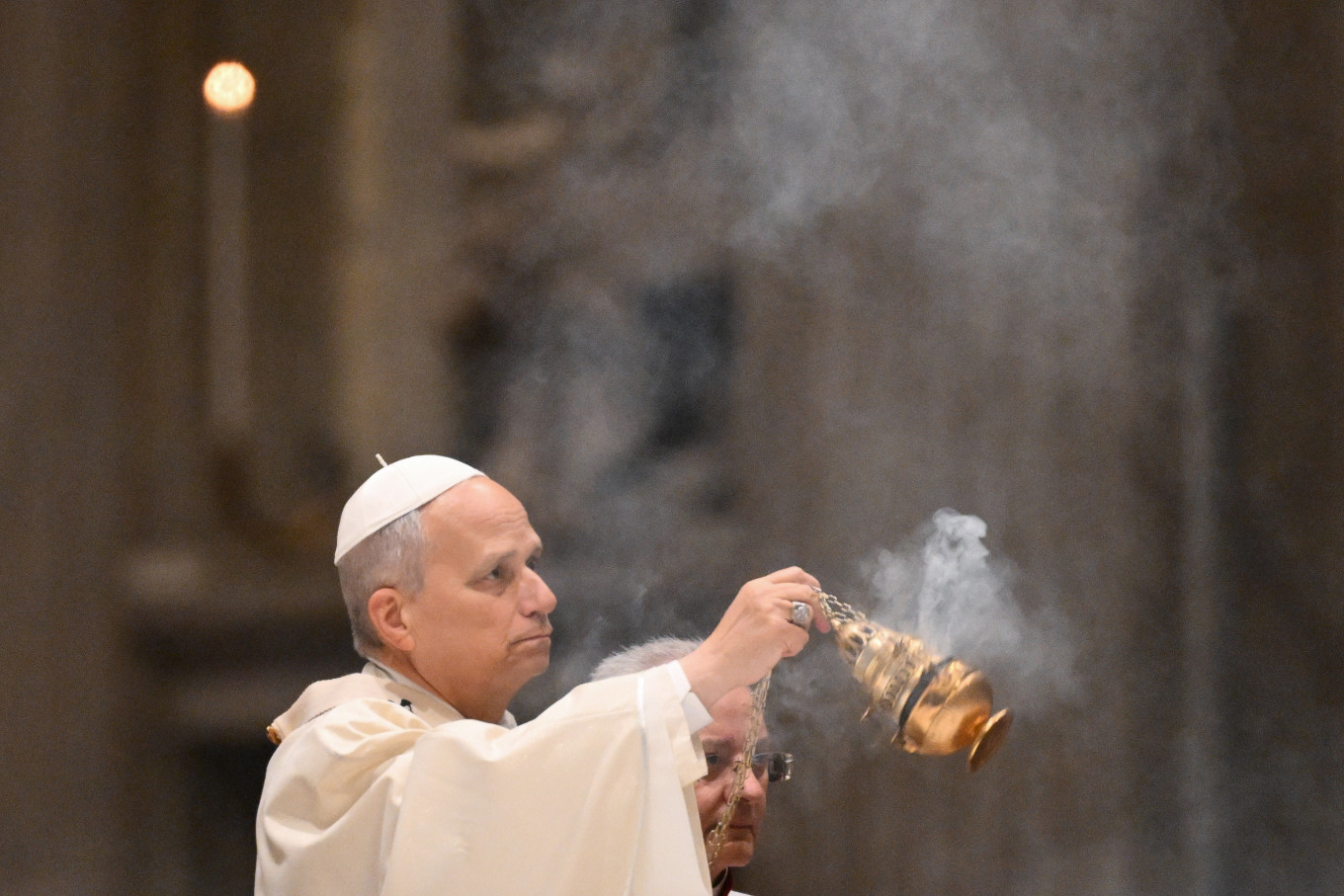 Pope Leo XIV swings a censer as he celebrates Mass on the 30th World Day of Consecrated Life on Feb. 2, 2026, at St. Peter’s Basilica in the Vatican. (AFP/Alberto Pizzoli)
A
rtificial intelligence is reshaping how we communicate, access information and work, how income and status are distributed, and even how we wage war. Yet the public conversation remains narrowly focused on the competition between AI labs or on abstract debates about the technology’s capabilities. Almost no one is asking what purpose AI ought to serve, or whether our current mindset, institutions, and control mechanisms are capable of steering the technology toward broad-based improvements in human welfare.
It was therefore refreshing to see Pope Leo XIV weigh in on the issue with his first encyclical, which describes AI’s current trajectory as a profound threat to human dignity. As an economist who has long argued that technologically driven outcomes are matters of choice, not fate, I welcome his intervention.
Leo is ahead of most commentators in pointing out that “technology is never neutral, because it takes on the characteristics of those who devise, finance, regulate and use it.” And yet, I worry that even he has not gone far enough on the most consequential question: What should AI be designed to do?
As Simon Johnson and I stress in our book Power and Progress: Our Thousand-Year Struggle over Technology and Prosperity, there are multiple paths that a technology like AI can take, and each has far-reaching implications for society. For example, the Pope is right to question the current trajectory of AI in warfare and law enforcement. What was taboo only a few years ago, AI-driven mass surveillance, algorithms selecting targets for killing, has become routine.
With many in Silicon Valley urging the United States to reinforce its hard power through a new military-algorithmic complex, Leo cautions that “Any technology that facilitates attacks without seeing the face of human beings lowers the moral threshold of conflict.” The Pope then calls for “disarmament of AI” to free “it from the mentality of ‘armed’ competition, which today is not limited simply to the military context, but is also an economic and cognitive phenomenon.”
A more fundamental piece of wisdom underlies these specific concerns: technological progress is not necessarily moral progress. Just because something is technically feasible does not mean that it is good for humanity. Whether a technology is desirable depends on who controls it and on the ideology and interests that guide them.

Leo does hint at what I see as the most immediate risk, namely that “while AI promises to boost productivity by taking over mundane tasks, it frequently forces workers to adapt to the speed and demands of machines, rather than designing machines to work with those who work.” But the Pope stops short of questioning the prevailing AI design philosophy. The entire AI industry’s approach is centered on mimicking human capabilities and automating human tasks, with the goal of creating an “artificial general intelligence” that can do everything a person can.