The Jakarta Post
Please Update your browser
Your browser is out of date, and may not be compatible with our website. A list of the most popular web browsers can be found below.
Just click on the icons to get to the download page.


Popular Reads
Top Results
No results found. Please check your search term and try again
Can't find what you're looking for?
View all search results
Popular Reads
Top Results
No results found. Please check your search term and try again
Can't find what you're looking for?
View all search resultsKeeping it free and active
As Washington pushes allies to gang up on Beijing, Indonesia must resist the pressure and stay true to its non-aligned roots, or risk becoming the mouse deer crushed between two fighting elephants.
Change text size
Gift Premium Articles
to Anyone
Share the best of The Jakarta Post with friends, family, or colleagues. As a subscriber, you can gift 3 to 5 articles each month that anyone can read—no subscription needed!
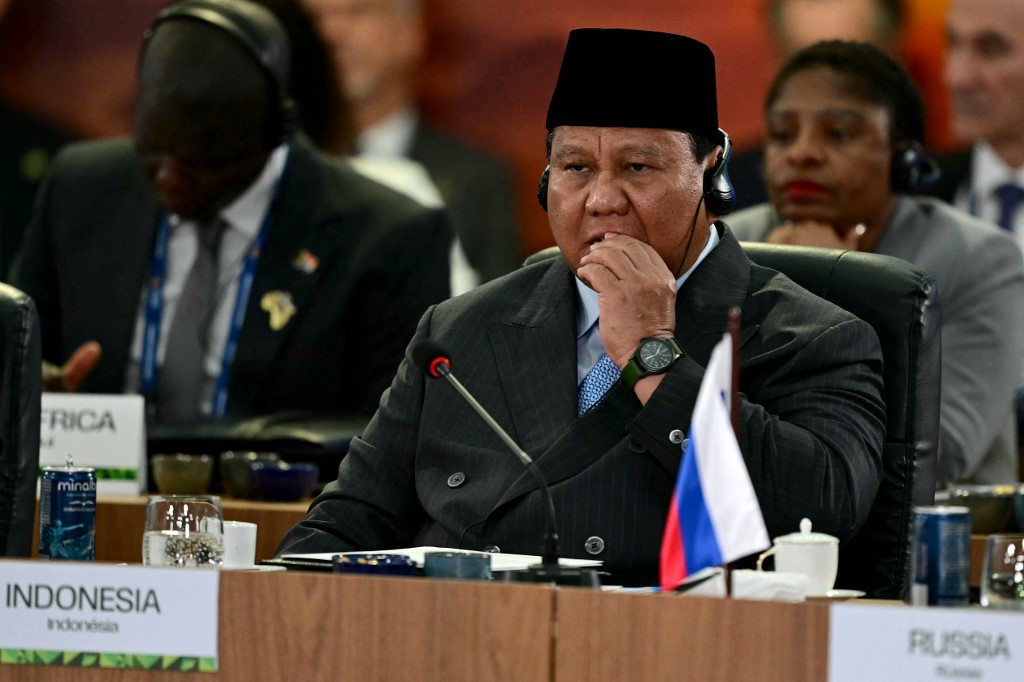 President Prabowo Subianto attends the BRICS summit second plenary session in Rio de Janeiro, Brazil, on July 6, 2025. (AFP/Pablo Porciuncula)
President Prabowo Subianto faces a grueling diplomatic marathon, with five major multilateral summits on his calendar before the year ends. If there was any doubt about the stakes, United States Treasury Secretary Scott Bessent cleared it up last week in North Carolina, putting pressure on Group of 20 (G20) peers to "gang up" on China. The signal is unmistakable: Jakarta must brace for full-blown friction between the world’s two economic heavyweights.
As an elected leader, Prabowo answers to the 1945 Constitution, which anchors Indonesia to a bebas aktif (free and active) foreign policy. Critics often dismiss the doctrine as rigid or outdated, but Indonesia’s contemporary history tells a clearer story: Every time a government strayed from nonalignment, it ended in diplomatic embarrassment and regret.
Navigating this turbulence demands a disciplined operation. Foreign Minister Sugiono must keep the cabinet singing the same tune, leaning on career diplomats at Pejambon and foreign missions rather than improvising on the fly. Prabowo is known for impulsive, spontaneous tendencies that may play well on the domestic campaign trail, but carry serious liabilities at high-stakes negotiating tables. He needs to keep them in check.
The President’s itinerary leaves little breathing room. Fresh off a trip to Vladivostok, Russia, Prabowo heads to New Delhi for the BRICS summit, followed quickly by the United Nations General Assembly in New York. While Beijing heavily influences BRICS as a counterbalance to the West, several members have recently dialed back their combative rhetoric under the shadow of renewed American tariff threats.
New Delhi offers a useful blueprint here. Prime Minister Narendra Modi’s government has quietly fought to stop BRICS from morphing into a reflexive, anti-Western coalition, even walking away without a joint ministerial statement in May when consensus conflicted with domestic interests. Prabowo should take note. He could demonstrate nonalignment without appearing rigid or unwilling to compromise; after all, BRICS is a non-binding club.
At the UN, Prabowo will likely find familiar ground. Except for founding father Sukarno, Indonesian heads of state have historically favored pragmatic diplomacy over grandstanding podium rhetoric. Attending the General Assembly for the second time, Prabowo knows how to conduct himself to reap the greatest benefit for Indonesia.

By November, the focus swings back to the Asia-Pacific: the APEC gathering in Shenzhen, China, followed by the ASEAN and East Asia summits in Manila. With US President Donald Trump potentially attending both, regional leaders can expect his signature pressure-cooker tactics.