The Jakarta Post
Please Update your browser
Your browser is out of date, and may not be compatible with our website. A list of the most popular web browsers can be found below.
Just click on the icons to get to the download page.


Popular Reads
Top Results
No results found. Please check your search term and try again
Can't find what you're looking for?
View all search results
Popular Reads
Top Results
No results found. Please check your search term and try again
Can't find what you're looking for?
View all search resultsIndonesia is pulling away the poor’s only ladder: Education
With Indonesian youth recording the world’s lowest faith in social mobility, misallocated public funds and crumbling classrooms threaten to turn the constitutional promise of education into an inescapable poverty trap.
Change text size
Gift Premium Articles
to Anyone
Share the best of The Jakarta Post with friends, family, or colleagues. As a subscriber, you can gift 3 to 5 articles each month that anyone can read—no subscription needed!
 Set as preferred source
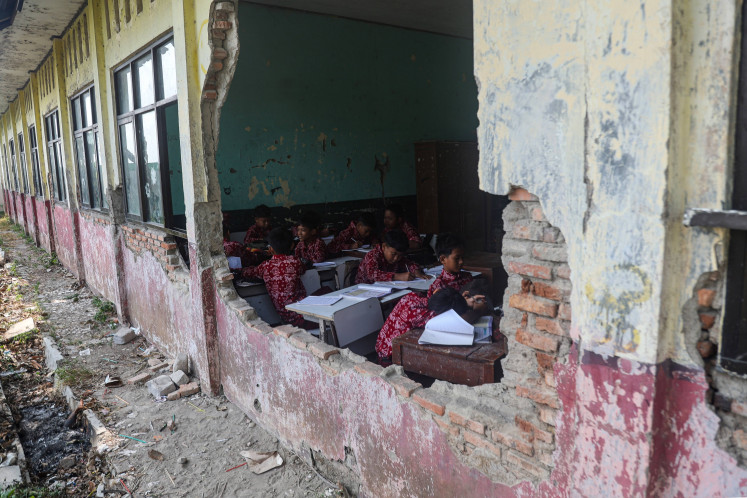
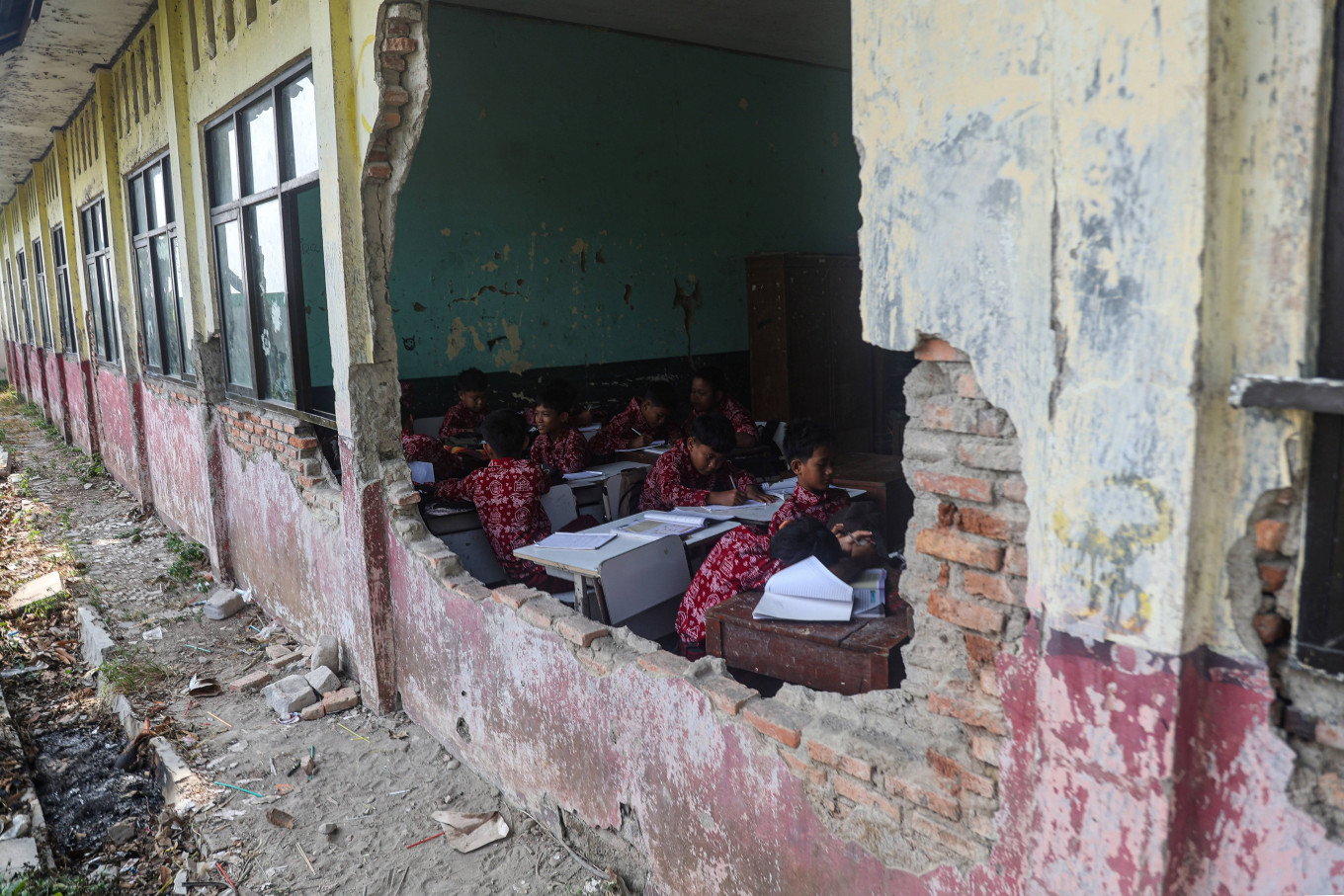 Pupils attend a class on Sept. 23 beside a collapsed wall at SD 3 Sukajadi state
elementary school in Sukakarya, Bekasi regency, West Java. According to the
school, three classrooms have been damaged for the past three years because of
the aging building, disrupting lessons and posing safety risks to students. (Antara/Darryl Ramadhan)
Pupils attend a class on Sept. 23 beside a collapsed wall at SD 3 Sukajadi state
elementary school in Sukakarya, Bekasi regency, West Java. According to the
school, three classrooms have been damaged for the past three years because of
the aging building, disrupting lessons and posing safety risks to students. (Antara/Darryl Ramadhan)
O
nly 32.4 percent of 15-year-old Indonesian students believe in upward social mobility. According to the Programme for International Student Assessment (PISA), this is the lowest figure recorded across all 91 evaluated countries.
This pervasive skepticism among Indonesian youth is not merely a statistical anomaly, it is a crisis of potential. PISA data indicates that students with a strong belief in social advancement demonstrate higher academic engagement and resilience. Because quality schooling remains the primary engine of socioeconomic mobility, this collapse in confidence directly erodes academic dedication, dimming the future of an entire generation.
Under the 1945 Constitution, the state is obligated to ensure that every citizen, regardless of socioeconomic background, can achieve their full potential. This social contract hinges on equitable, high-quality public education, the great equalizer between the privileged and the marginalized. Today’s fiscal choices will dictate whether millions of young Indonesians enter productive, dignified livelihoods in line with the Golden Indonesia 2045 vision or remain entrenched in generational poverty.
On paper, Indonesia appears committed: the Constitution mandates that at least 20 percent of the state budget be allocated to education. In practice, however, public spending tells a different story. In 2023, Indonesia’s public education expenditure stood at just 1.3 percent of GDP, trailing the ASEAN-6 average of 2.8 percent and barely a third of the 3.6 percent benchmark typical of upper-middle-income peers. Measured against the scale of its economy, Indonesia is severely underinvesting in human capital.
More than two decades of constitutional earmarking have failed to secure basic educational infrastructure. Data from the Elementary and Secondary Education Ministry reveals that 83 percent of the country’s 1.57 million accredited schools fail to meet Grade "A" under the National Education Standard (SNP). Dilapidated physical spaces remain a critical bottleneck: 55.1 percent of classrooms nationwide are substandard, with elementary schools suffering the brunt, 61.2 percent of their classrooms are in varying stages of disrepair.
World Bank analyses trace this chronic inefficiency to rigid budget allocations and weak institutional capacity among sub-national governments (SNGs). Because teacher salaries and allowances swallow the bulk of regional transfer funds, local authorities are left with negligible discretionary capital to invest in pedagogy, learning tools or classroom interventions that directly move the needle on student achievement.

Rather than addressing these systemic shortfalls, the current administration’s fiscal priorities risk exacerbating them. In 2025, the flagship free nutritious meal program absorbed up to 28.9 percent of the national education budget, crowding out resources desperately needed for frontline school quality. While the Constitutional Court ruled that free meals funding must be decoupled from the 20 percent constitutional education earmark, that mandate will not take full effect until 2028.