TheJakartaPost

Please Update your browser

Your browser is out of date, and may not be compatible with our website. A list of the most popular web browsers can be found below.
Just click on the icons to get to the download page.


Jakarta Post

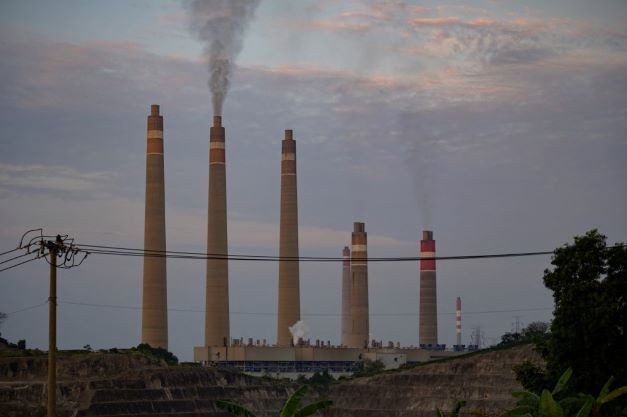
Some coal power plants may be labeled ‘green’ in revised classification

Experts say such a move would be a major step back in the country's journey toward lower carbon emissions.

Aditya Hadi (The Jakarta Post)
Jakarta
Fri, September 8, 2023 Published on Sep. 7, 2023 Published on 2023-09-07T18:03:17+07:00

Change text size

Gift Premium Articles
to Anyone

Share the best of The Jakarta Post with friends, family, or colleagues. As a subscriber, you can gift 3 to 5 articles each month that anyone can read—no subscription needed!

T

he Financial Services Authority (OJK) is considering labeling coal-fired power plants “green” if they are connected to supply chains for sustainable industries, such as those of electric vehicles (EVs).

Experts have criticized the idea and said such a move would be a major step back in the country's commitment to limit carbon emissions. Rather than mobilizing investment for the country, categorizing the burning fossil fuels to produce electricity as a green business activity would undermine the credibility of the taxonomy and hurt the country's financial firms.

Indonesian Green Taxonomy (THI) Version 1.0 was released last year, but OJK chairman Mahendra Siregar said the agency was in the process of revising the document in response to changes made to the ASEAN Taxonomy for Sustainable Finance in June.

Notably, the second version of the ASEAN Taxonomy includes the early retirement of coal-fired power plants in the green category, thereby making such activities eligible for sustainable financing.

"It is the first taxonomy in the world that recognized [the early retirement of coal-fired power plants] as green. In other countries or forums, the activity can be called green only if it is in a package with the construction of renewable energy power plants," Mahendra explained in a press conference on Tuesday.

He added that the OJK was mulling over the idea of also placing in that category coal-fired power plants used to supply energy for green and sustainable industries, such as the manufacture of EVs and EV batteries.

"Could the energy to produce such products not be categorized as green? We are in the process of conducting further studies on that," Mahendra said.

He explained that, in revising the taxonomy, the OJK needed to check whether the products of certain supply chains could have positive impacts on green and renewable energy.

He also stressed the importance of balancing environmental policies with social advancement and economic development.

"There is a possibility for calculations to state that as a single integrated union, [a supply chain] could be categorized as green," he said.

The OJK is the government agency tasked with producing the THI in collaboration with several ministries, including the Environment and Forestry Ministry and the Energy and Mineral Resources Ministry. In the process, it is also receiving input from Bank Indonesia and the Finance Ministry’s Fiscal Policy Agency (BKF).

Greenwashing risk

Pius Ginting, coordinator of the Association of People's Emancipation and Ecological Action (AEER), said categorizing coal-fired power plants in transitional mineral areas as green contradicted principles of social justice and environmental justice.

"The number of people living around [critical] mineral industry areas and experiencing respiratory problems because of the worsening air has increased in the industrial area of Morowali, Weda Bay [Central Sulawesi]," he said in a statement.

Meanwhile, the Asia energy finance campaigner from pressure group Market Forces, Binbin Mariana, said categorizing financing for the construction of coal-fired power plants as green created a risk of “greenwashing” by Indonesian banks.

"It's very concerning that transition-washing is on the rise as green finance is being used to fund high-carbon companies that do not have a credible plan to shift their business away from fossil fuels," she said.

Bhima Yudhistira, executive director at the Center of Economic and Law Studies (CELIOS), worried that a taxonomy that still accommodated fossil-fuel-based energy financing would reduce banks' interest in financing renewable energy. Ultimately, the renewables share in the energy mix would remain small.

Furthermore, Bhima explained that if large amounts of money are spent to build new coal-fired power plants in downstream supply chains, this could cause problems with marketing the products of said supply chains, as prospective buyers like EV companies may look for alternative, greener sources, while consumers would grow skeptical about the shift to EVs.

"There are dark riders in the green taxonomy development process. THI 2.0 [is supposed to] no longer [accommodate] business sectors that contribute to the carbon emission increase," he said.

Ahmad Ashov Birry, a coordinator of the antipollution and anticorruption movement #BersihkanIndonesia, opined that the OJK's plan would negatively impact the country's energy transition, including the Just Energy Transition Partnership (JETP).

"We will see whether the JETP will experience a further setback and compel President [Joko “Jokowi” Widodo], [United States] President [Joe] Biden, [Japanese] Prime Minister [Fumio] Kishida and others to speak with a forked tongue," Ahmad said.

Similarly, the Institute for Energy Economics and Financial Analysis (IEEFA) contends that labeling coal-fired power plants green could mislead investors who want assurances that their assets are environmentally friendly. That, according to the US-based think tank, could see Indonesia lose high-quality foreign direct investment (FDI) and render the taxonomy ineffective.

"If the country goes ahead with the latest idea of using the energy transition to justify new plants' eligibility for green finance, its taxonomy would be the first to recognize coal as green. Not only would national credibility be hurt, but the move might also border on state-sanctioned greenwashing," the institute said in a recent report.

Furthermore, the IEEFA said the OJK's plan could jeopardize the reputation of domestic financial players if they blindly support investments in coal-fired power plants on the sole basis of the green label in the taxonomy.

"The OJK appears to believe that it is acceptable to call projects green if they are critical to the economy. However, the authority is making the mistake of confusing a transition need with providing certainty and clarity to investors that its taxonomy is backed by science," the IEEFA said.

Your Opinion Matters

Share your experiences, suggestions, and any issues you've encountered on The Jakarta Post. We're here to listen.

Enter at least 30 characters
0 / 30

Thank You

Thank you for sharing your thoughts. We appreciate your feedback.

Share options

Quickly share this news with your network—keep everyone informed with just a single click!

Change text size options

Customize your reading experience by adjusting the text size to small, medium, or large—find what’s most comfortable for you.

Gift Premium Articles
to Anyone

Share the best of The Jakarta Post with friends, family, or colleagues. As a subscriber, you can gift 3 to 5 articles each month that anyone can read—no subscription needed!

Continue in the app

Get the best experience—faster access, exclusive features, and a seamless way to stay updated.