The Jakarta Post
Please Update your browser
Your browser is out of date, and may not be compatible with our website. A list of the most popular web browsers can be found below.
Just click on the icons to get to the download page.


Popular Reads
Top Results
No results found. Please check your search term and try again
Can't find what you're looking for?
View all search results
Popular Reads
Top Results
No results found. Please check your search term and try again
Can't find what you're looking for?
View all search resultsacid-attack
Politics 5 months ago
PREMIUM
Gibran’s ad hoc judges proposal in acid attack case draws legal doubt
A proposal by Vice President Gibran Rakabuming Raka to involve ad hoc judges in the trial of acid attack victim Andrie Yunus has drawn skepticism from legal experts, while civil society groups welcomed it as reinforcing their demand for the case to be tried in civilian court.

Academia 5 months ago
PREMIUM
New legal paradigm demands an end to impunity
The transfer of Andrie Yunus’s acid attack case to a military court threatens to shield perpetrators behind a "wall of impunity." To uphold the rule of law, Indonesia must prioritize civilian jurisdiction and establish an independent fact-finding team.
Politics 5 months ago
PREMIUM
TNI hands over acid attack case to military prosecutors
If it meets certain requirements, the case against four Indonesian Military (TNI) Strategic Intelligence Agency (BAIS) members in the acid attack on human rights defender Andrie Yunus will be tried by a military court.

Politics 5 months ago
PREMIUM
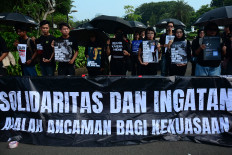
Protesters demand justice for assaulted activist as top court reviews military law
Civil groups and students staged a rally outside the Constitutional Court on Wednesday in solidarity with acid attack victim Andrie Yunus, as the top court hears cases challenging the Indonesian Military (TNI) Law.
Opinion 5 months ago
PREMIUM
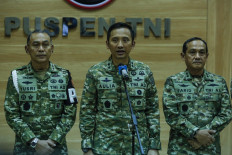
Analysis: The shadow of the TNI power struggle behind the acid attack
Three weeks after the acid attack on Commission for the Disappeared and Victims of Violence (Kontras) activist Andrie Yunus, investigators have yet to clearly identify who bears ultimate responsibility. What has drawn particular attention is the resignation of the chief of the Strategic Intelligence Agency (BAIS), framed by the Indonesian Military (TNI) as a form of institutional accountability. Yet, this raises the critical question of whether the move reflects genuine responsibility-taking by the state or signals deeper power struggles within the military.
Politics 5 months ago
PREMIUM
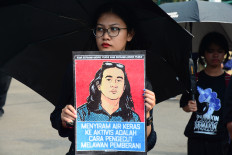
Acid attack ‘threat’ to young generation’s freedom
The assault on Andrie Yunus of the Commission for Missing Persons and Victims of Violence (Kontras) was not a personal attack, but instead an attack on "young people who continue to fight for a just and humane Indonesia", activists said.

Politics 5 months ago
PREMIUM
Press groups decry govt’s restriction of Magdalene’s acid attack post
Journalist associations have condemned the Communications and Digital Ministry’s move to geographically restrict an Instagram post by online news outlet Magdalene about a recent acid attack involving the military, calling it illegal and a dangerous precedent for press freedom.
Opinion 5 months ago
PREMIUM
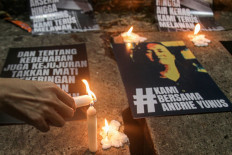
Analysis: Acid attack puts spotlight on Prabowo’s human rights commitment
President Prabowo Subianto is hardly known for his commitment to human rights, not since taking up the presidency in October 2024 and certainly not during his Army years. He rarely addresses the issue in public, delegating it instead to his Human Rights Minister Natalius Pigai to answer questions on the topic.
Politics 5 months ago
PREMIUM
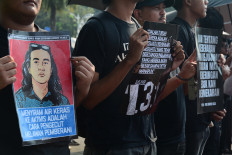
Witnesses, activists in Andrie case subject to threats
At least 12 people have made reports to the National Commission on Human Rights (Komnas HAM) about the online abuse they received on social media and other online communication platforms and requested the commission’s protection.
Academia 5 months ago
PREMIUM
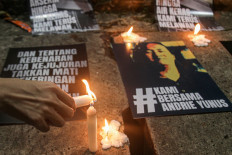
Human rights commitment at risk: What survives after the acid attack
The brutal acid attack on activist Andrie Yunus is more than a personal tragedy; it is a calculated message intended to silence Indonesian dissent. When justice stops at the surface, it doesn't end the violence—it merely masks a deepening era of state-sponsored terror.
Editor's Picks
Popular
- Popular discontent is justified. Authoritarianism is not the answer
- Recentralization concerns in fiscal, education heighten
- Sugarcane farmers query House over sugar imports
- Govt under pressure as 3 million home drive hits cracks
- Safeguarding Indonesia's AI future
- Power exports to Singapore hinge on regulatory clarity
- Thousands huddle in Bangkok shelters as Thai flood damages seen at $320m
- Prabowo turns to experts to tackle peatland fires after swipe at researchers
- Stocks plunge as IDX lowers minimum price cap
- Palestine test for UN ‘resilience’, says Indonesia


