The Jakarta Post
Please Update your browser
Your browser is out of date, and may not be compatible with our website. A list of the most popular web browsers can be found below.
Just click on the icons to get to the download page.


Popular Reads
Top Results
No results found. Please check your search term and try again
Can't find what you're looking for?
View all search results
Popular Reads
Top Results
No results found. Please check your search term and try again
Can't find what you're looking for?
View all search resultssovereignty
Academia 5 months ago
PREMIUM
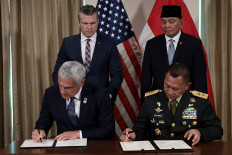
Indonesia’s airspace torn between sovereignty and partnership
If Indonesia approves new military overflight arrangements with the United States, it will face a high-stakes balancing act between strategic partnership and national autonomy. In an era of shifting global power, control of Indonesia’s skies must remain a matter of substance, not just symbolism.
Americas 5 months ago
PREMIUM
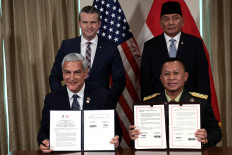
Sovereignty concerns loom over new security pact with US
The upgraded Indonesia-United States security agreement, the Major Defense Cooperation Partnership (MDCP), has been shadowed by reports on Washington’s proposal for blanket overflight access for its military aircraft in Indonesia’s airspace.

Archipelago 5 months ago
PREMIUM
Construction continues on Karang Singa beacon tower off Bintan: Official
A provincial official has underlined the urgency of the national strategic project, initiated in 2021 and funded by the Defense Ministry, as both a navigational aid a symbol of state sovereignty in the maritime zone off the Singapore Strait.

Academia 5 months ago
PREMIUM
Why user states must share the burden of Indonesia’s sea-lanes
As the case of the Strait of Hormuz in the Iran war illustrates amid escalating global tensions, Indonesia can no longer afford to be the sole guardian of the world’s most dangerous maritime choke points: It’s time for user states to pay their fair share.

Academia 5 months ago
PREMIUM
Familiar interventions, graver consequences in a region in churn
As the Middle East undergoes a violent restructuring, the failures of Western-led regime changes offer a grim warning. For India, navigating this "region in churn" requires a masterclass in strategic autonomy and the pursuit of a new regional compact.
Academia 5 months ago
PREMIUM
Smart air defense systems: A new chapter in modern air warfare
Iran’s model of smart air defense, combining geographic fragmentation, asymmetric resource management and layered deterrence, warrants a close study by developing countries such as Indonesia toward restructuring the national security doctrine for an integrated, hybrid approach.
Academia 6 months ago
PREMIUM
An unjust war against a repressive regime is an unjust war
Iran may be indefensible, but that does not make an illegal war against it justifiable. By remaining silent, Indonesia is not choosing neutrality; it is choosing to abandon its founding principles in the face of raw coercion.
Editorial 6 months ago
PREMIUM
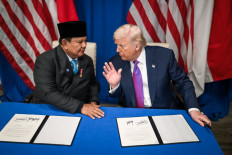
Sovereignty for soybeans?
We should use this inadvertent grace period due to the US Supreme Court's ruling to review the ART scrupulously to see what we're actually gaining or losing, and make doubly sure that we haven't traded our sovereignty through an alliance pact disguised as a trade deal.

Academia 6 months ago
PREMIUM
Presidency for all: Indonesia’s human rights diplomacy
As Indonesia takes the helm of the UN Human Rights Council for the first time, we are championing a "Presidency for all" that bridges global divides and centers on human dignity. This historic leadership marks our commitment to proving that democratic resilience at home can drive principled, inclusive justice on the world stage.

Editor's Picks
Popular
- Indonesia calls for more representative UN amid changing world order
- Safeguarding Indonesia's AI future
- Recentralization concerns in fiscal, education heighten
- Twenty years on, BRICS faces a defining choice
- Jakarta water shortages worsen as dry season drags on
- Indian arrested for smuggling gold bars to Thailand via N. Sumatra airport
- Singapore’s BDx launches 640MW data center project in West Java
- Court decision tightens House oversight on free meals funding
- Govt under pressure as 3 million home drive hits cracks
- Gontor leader’s blunt remarks highlight ‘pesantren’ political independence


