TheJakartaPost
Please Update your browser
Your browser is out of date, and may not be compatible with our website. A list of the most popular web browsers can be found below.
Just click on the icons to get to the download page.


Popular Reads
Top Results
No results found. Please check your search term and try again
Can't find what you're looking for?
View all search results
Popular Reads
Top Results
No results found. Please check your search term and try again
Can't find what you're looking for?
View all search resultsRCEP: Test to ASEAN in the Asia Pacific
The RCEP emphasizes ASEAN centrality. It also undermines ASEAN and its dialogue partners.
Change text size
Gift Premium Articles
to Anyone
Share the best of The Jakarta Post with friends, family, or colleagues. As a subscriber, you can gift 3 to 5 articles each month that anyone can read—no subscription needed!
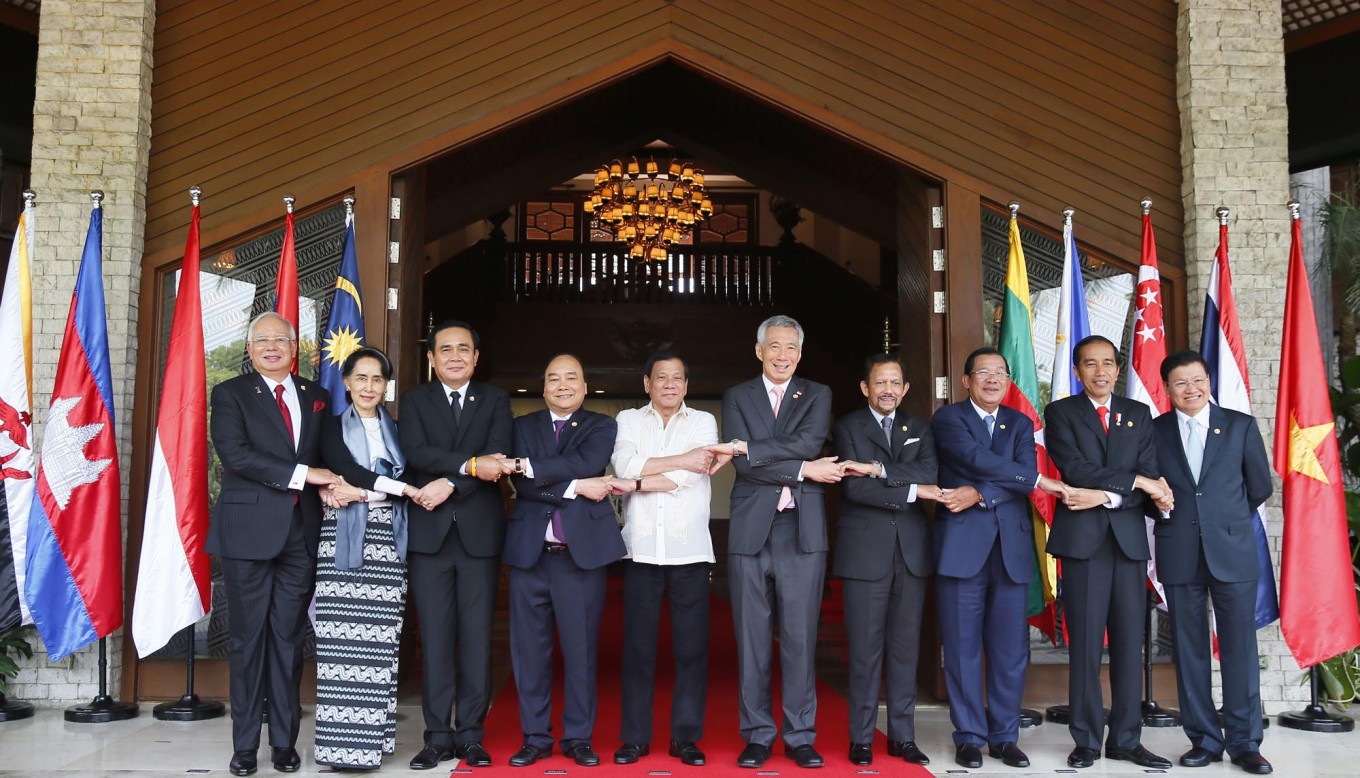 Southeast Asian leaders prepare to link arms as they pose for a family photo following their retreat in the 30th ASEAN Leaders' Summit Saturday, April 29, 2017 in Manila, Philippines. From left, Malaysian Prime Minister Najib Razak, Myanmar State Counsellor Aung San Suu Kyi, Thai Prime Minister Prayuth Chan-ocha, Vietnamese Prime Minister Nguyen Xuan Phuc, Philippine President Rodrigo Duterte, Singapore Prime Minister Lee Hsien Loong, Brunei's Sultan Hassanal Bolkiah, Cambodian Prime Minister Hun Sen, Indonesian President Joko Widodo and Lao Prime Minister Thongloun Sisoulith. (AP/Bullit Marquez)
S
outheast Asia is undoubtedly one of world’s important economic growth engines. Statistics of the World Trade Organization show that the percentage of global merchandise exports from the region increased almost 16=fold between 1980 and 2016 from US$72 billion to $1.079 trillion. Other developing regions, remained mostly constant and developed regions declined.
The region has also seen stable economic growth, the latest figures showing a growth rate of 4.7 percent in 2016, above the estimated global average growth rate of 3.1 percent for the year.
As the world sets its eyes on the region, Southeast Asian nations must brace themselves for attempts to establish a regional economic architecture by countries seeking to capitalize on the region’s economic development and market.
Just to name a few: the (now defunct) Trans-Pacific Partnership (TPP) and the Free Trade Area of the Asia-Pacific (FTAAP).
In the face of this race, ASEAN members have two choices: first, to take a passenger-seat in an external party-led initiative and be driven by external parties, or second, take the driver’s seat and lead the initiative, taking destiny into their own hands.
In 2011, ASEAN decided on the latter. Then the ASEAN chair, Indonesia proposed a broader regional economic integration pact now called the Regional Comprehensive Economic Partnership (RCEP).
The basis for this initiative is the pre-existing ASEAN FTA with six ASEAN dialogue partners — Australia, China, India, Japan, the Republic of Korea and New Zealand.