The Jakarta Post
Please Update your browser
Your browser is out of date, and may not be compatible with our website. A list of the most popular web browsers can be found below.
Just click on the icons to get to the download page.


Popular Reads
Top Results
No results found. Please check your search term and try again
Can't find what you're looking for?
View all search results
Popular Reads
Top Results
No results found. Please check your search term and try again
Can't find what you're looking for?
View all search resultsNusantara prepares to start development of legislative, judicial complexes
Change text size
Gift Premium Articles
to Anyone
Share the best of The Jakarta Post with friends, family, or colleagues. As a subscriber, you can gift 3 to 5 articles each month that anyone can read—no subscription needed!
 Set as preferred source
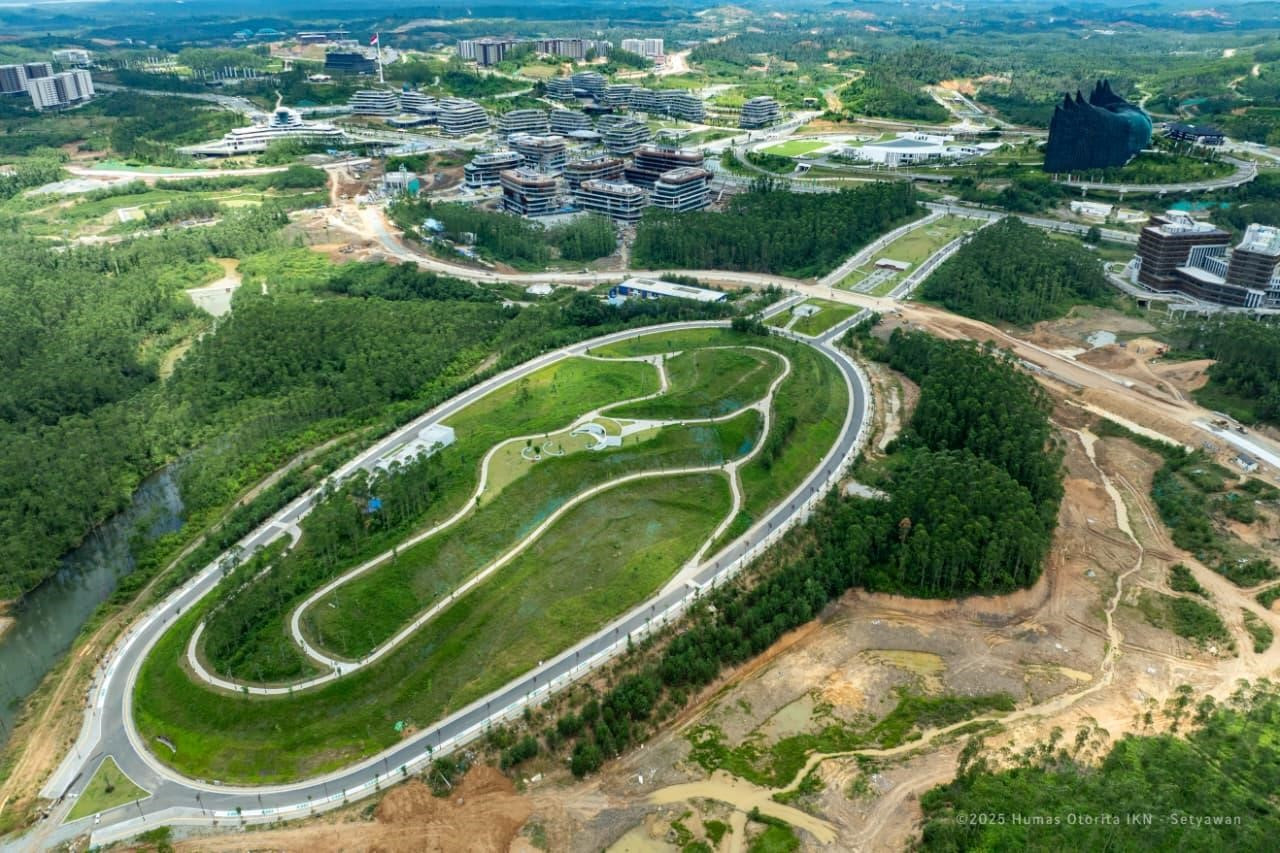 The development of the Legislative and Judicial Plaza is slated to begin in November, with the signing of the contract with the winning service provider to be carried out at the end of October or November. (Courtesy of Nusantara National Capital Authority)
F
ollowing the issuance of Presidential Regulation No. 79/2025, which designated Nusantara as the future center of government, the Nusantara Capital City (IKN) Authority has begun the preparatory phase for the development of the legislative and judicial area ecosystem.
The construction of both complexes, estimated to take 25 months, starts in November.
Under the plan, the legislative office complex will be built on 42 hectares with a budget of Rp 8.5 trillion for the 2025 to 2027 period. This will include the Plenary Session Building, Democracy Plaza, Deliberation Veranda, Museum and other office buildings.
Meanwhile, the 15-ha judicial complex, with a budget of Rp 3.1 trillion, will house the Constitutional Court, Judicial Commission and Supreme Court.
The budget for the development of the Nusantara infrastructure will come from three financing schemes: the state budget of Rp 48.8 trillion (2025–2028), public-private partnerships (PPPs) with an estimated value of Rp 158.72 trillion and purely private investment with an estimated value of Rp 66.3 trillion as of October.
IKN Authority chairman Basuki Hadimuljono emphasized that the second phase of construction will accelerate following the presidential regulation.
"Physical and non-physical development in Nusantara will be even more massive. Currently, around 7,000 construction workers live in construction worker housing. In the second phase, the number of workers is estimated to reach 20,000 to accelerate the development of the capital city," he explained.
In addition, other priority developments including the Sepaku Market, the National Mosque and the Basilica are targeted for completion and operation by the end of 2025. Other supporting facilities such as road connectivity in the Central Government District (KIPP) Sub-WP 1B and 1C, housing, markets and educational facilities are also being prepared to support the relocation of civil servants to Nusantara.
The IKN Authority is also ensuring the raw water supply for Nusantara through the Sepaku Semoi Dam, which covers an area of 800-900 ha and has a storage capacity of 16 million cubic meters.
The dam is capable of providing 2,500 liters of raw water per second, of which 1,500 liters per second will be channeled to Nusantara and 1,000 liters per second will be channeled to Balikpapan. In addition, the Sepaku Intake has also been prepared with a water treatment plant with a capacity of 300 liters per second, ensuring that water flowing through Nusantara is potable.
In preparation for the establishment of a Special Regional Government (Pemdasus), the IKN Authority has partnered with Gajah Mada University’s Jimly School of Law and Government to comprehensively design the regulations and structure of the Pemdasus.
At the same time, a collaborative program with the Bandung Institute of Technology (ITB) will see 1,000 high school and vocational school students trained to become content creators, aiming to encourage the use of the digital economy and open economic opportunities. Furthermore, approximately 879 capacity building programs have been held for the community, including mothers, people with disabilities and micro, small and medium enterprises (MSMEs).