The Jakarta Post
Please Update your browser
Your browser is out of date, and may not be compatible with our website. A list of the most popular web browsers can be found below.
Just click on the icons to get to the download page.


Popular Reads
Top Results
No results found. Please check your search term and try again
Can't find what you're looking for?
View all search results
Popular Reads
Top Results
No results found. Please check your search term and try again
Can't find what you're looking for?
View all search resultsConstitutional experts oppose revival of New Order-era policy guidelines
Change text size
Gift Premium Articles
to Anyone
Share the best of The Jakarta Post with friends, family, or colleagues. As a subscriber, you can gift 3 to 5 articles each month that anyone can read—no subscription needed!
 Set as preferred source
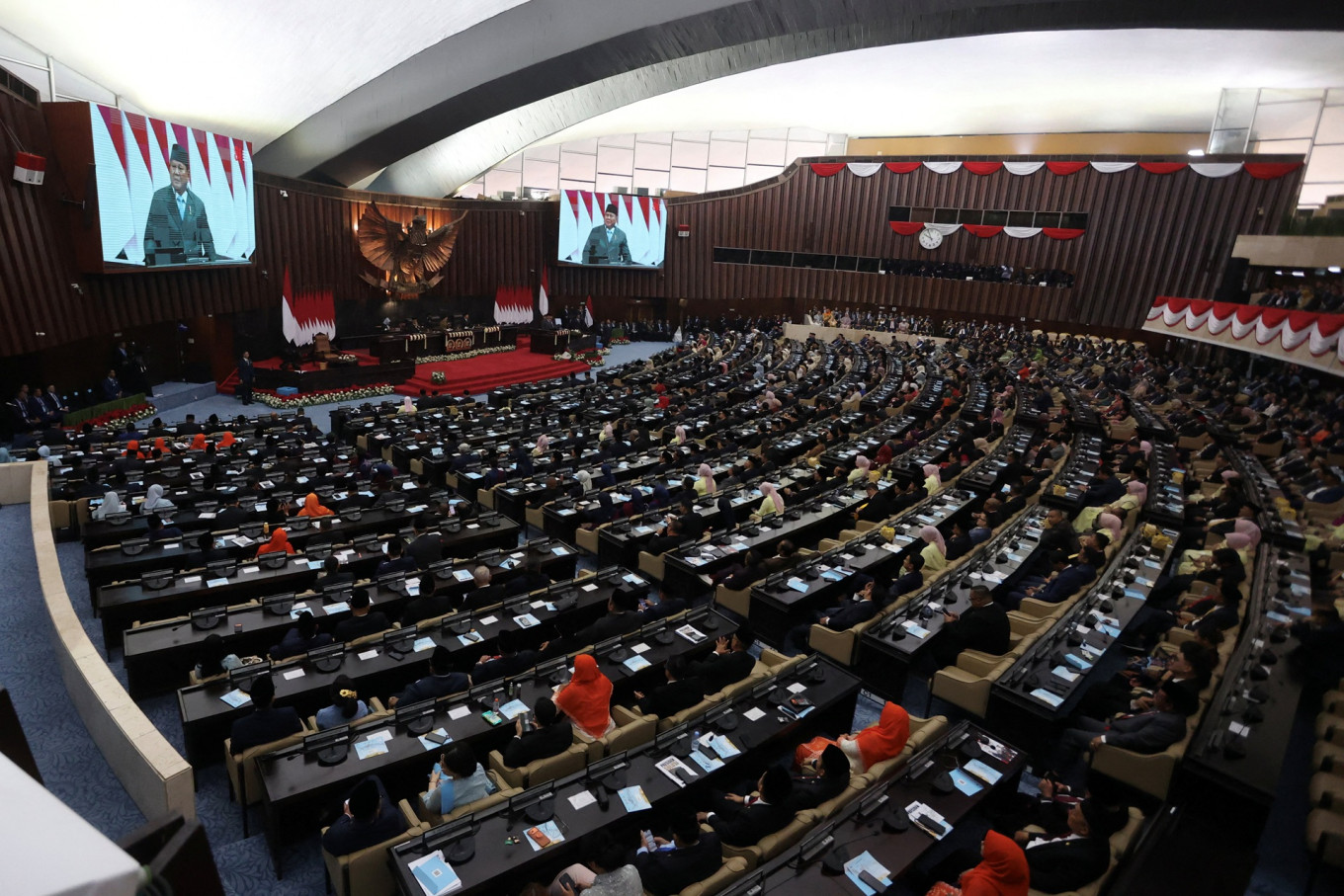 President Prabowo Subianto is displayed on screens as he delivers his annual State of the Nation address ahead of the country's 81st Independence Day anniversary in front of the members of the legislative bodies during the People's Consultative Assembly (MPR) plenary session on Aug. 14 at the Senayan Legislative Complex in Central Jakarta. (Reuters/Stringer)
C
onstitutional experts have pushed back against efforts to revive long-defunct state policy guidelines, warning that the proposal risks restoring the total political authority that the People’s Consultative Assembly (MPR) had during the New Order era.
Talks on the proposed state policy outlines (PPHN), a long-term national development framework intended to guide policymaking across successive presidential administrations, continued to resurface after MPR leaders presented President Prabowo Subianto with the latest draft earlier this month.
The plan gained fresh attention in the past few days, as MPR deputy speaker Eddy Soeparno said on the sidelines of the annual MPR plenary session last Friday that discussions were still ongoing following the meeting with Prabowo. Eddy said the MPR would conduct more studies to find the most suitable legal avenue for adopting the PPHN from three options they are currently considering: through a constitutional amendment, an MPR decree or legislation passed by the House of Representatives.
The PPHN are widely seen as echoing the long-defunct state policy guidelines (GBHN) used under the authoritarian New Order era of the late president Soeharto, Prabowo’s former father-in-law. Before it was removed following Soeharto’s fall in 1998, the MPR was the country’s highest state institution and had the authority to appoint the president.
Read also: Proposal on New Order-style policy guidelines needs more research, says MPR
Constitutional experts have now grown more vocal against the plan, questioning its necessity and warning that giving the PPHN binding force could reverse democratic principles established in Indonesia’s post-Reform constitutional system.

“We do not need the PPHN to become a development planning document since we already have the RPJP and RPJMN,” Yance Arizona, a constitutional law lecturer at Gadjah Mada University, told The Jakarta Post on Monday, referring to existing long-term and medium-term development plans.