The Jakarta Post
Please Update your browser
Your browser is out of date, and may not be compatible with our website. A list of the most popular web browsers can be found below.
Just click on the icons to get to the download page.


Popular Reads
Top Results
No results found. Please check your search term and try again
Can't find what you're looking for?
View all search results
Popular Reads
Top Results
No results found. Please check your search term and try again
Can't find what you're looking for?
View all search resultsIndonesia AI’s strategy: Economically ambitious, socially hollow
Indonesia is charging headlong into an artificial Iintelligence-driven economy, but its current road map leaves the nation’s most vulnerable workers in a blind spot. To prevent a catastrophic "race to the bottom," the government must balance its hunger for innovation with a radical redesign of the social safety net.
Change text size
Gift Premium Articles
to Anyone
Share the best of The Jakarta Post with friends, family, or colleagues. As a subscriber, you can gift 3 to 5 articles each month that anyone can read—no subscription needed!
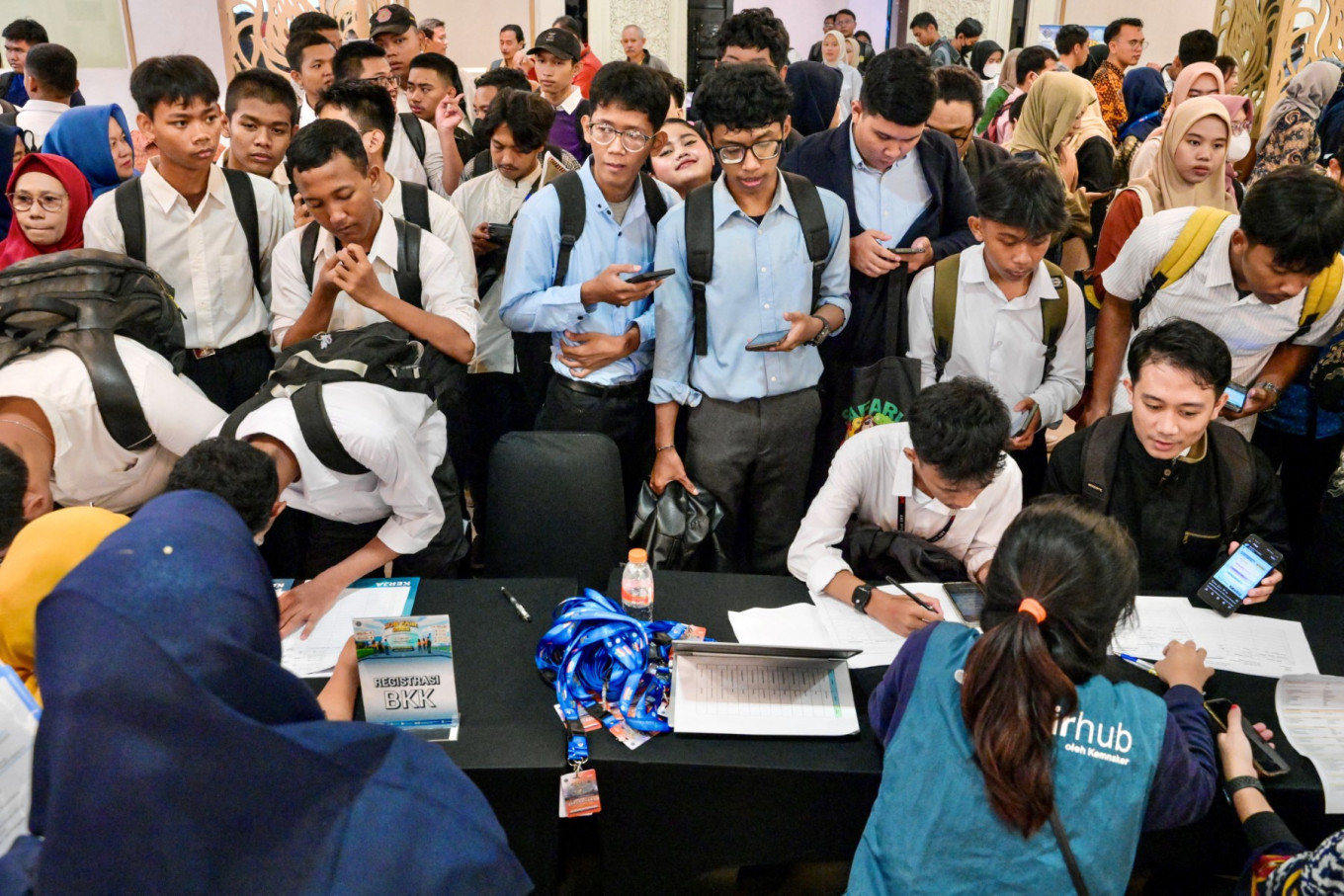 Jobseekers register themselves on May 22, 2025, during a job fair attended by over a hundred recruiting companies and thousands of jobseekers in Jakarta. (AFP/Bay Ismoyo)
T
he rapid development of artificial intelligence has revived a classical debate in economics regarding technological unemployment. Will AI innovation bring shared prosperity, or create an unprecedented unemployment crisis?
This is not merely a theoretical inquiry for academic journals. Current AI systems are already demonstrating a capacity for complex reasoning that rivals human experts in high-stakes fields such as business strategy, legal analysis and sophisticated software engineering.
According to the McKinsey Global Institute, the scale of this shift is staggering, with estimates suggesting that up to 375 million workers globally - roughly 14 percent of the global workforce - will need to transition into entirely new occupational categories by 2030. As this inevitable force of economic disruption gains momentum, it is imperative to critically assess Indonesia’s strategic preparedness.
While Indonesia’s current policy framework signals a robust commitment to establishing an AI-driven economy, there is a glaring disparity in its focus. The necessary mitigative measures designed to address the undesirable socio-economic consequences of AI remain dangerously underdeveloped.
At the heart of the nation's strategy is the proposed Presidential Decree of the National Artificial Intelligence Road Map 2026–2029. This document is intended to serve as the definitive anchor for Indonesia’s technological trajectory over the next four years, centering on four primary pillars: strengthening stakeholder involvement, fostering domestic innovation, increasing research capabilities and mitigating systemic risks.
However, a closer look at the road map’s 45 detailed programs reveals a lopsided priority list. Approximately 90 percent of these initiatives are aggressively directed toward "offensive" strategies - preparing AI talent, building innovation ecosystems, expanding physical infrastructure and courting international investment.

In contrast, only five programs are dedicated to the "defensive" side of the equation: the social and economic risks of displacement. This composition reveals a single-minded objective: the rapid acceleration of AI adoption at any cost.