The Jakarta Post
Please Update your browser
Your browser is out of date, and may not be compatible with our website. A list of the most popular web browsers can be found below.
Just click on the icons to get to the download page.


Popular Reads
Top Results
No results found. Please check your search term and try again
Can't find what you're looking for?
View all search results
Popular Reads
Top Results
No results found. Please check your search term and try again
Can't find what you're looking for?
View all search resultsThe real threat to NATO
NATO members no longer share a coherent understanding of the values, economic order, geopolitical vision and legal principles it was created to defend.
Change text size
Gift Premium Articles
to Anyone
Share the best of The Jakarta Post with friends, family, or colleagues. As a subscriber, you can gift 3 to 5 articles each month that anyone can read—no subscription needed!
 Set as preferred source
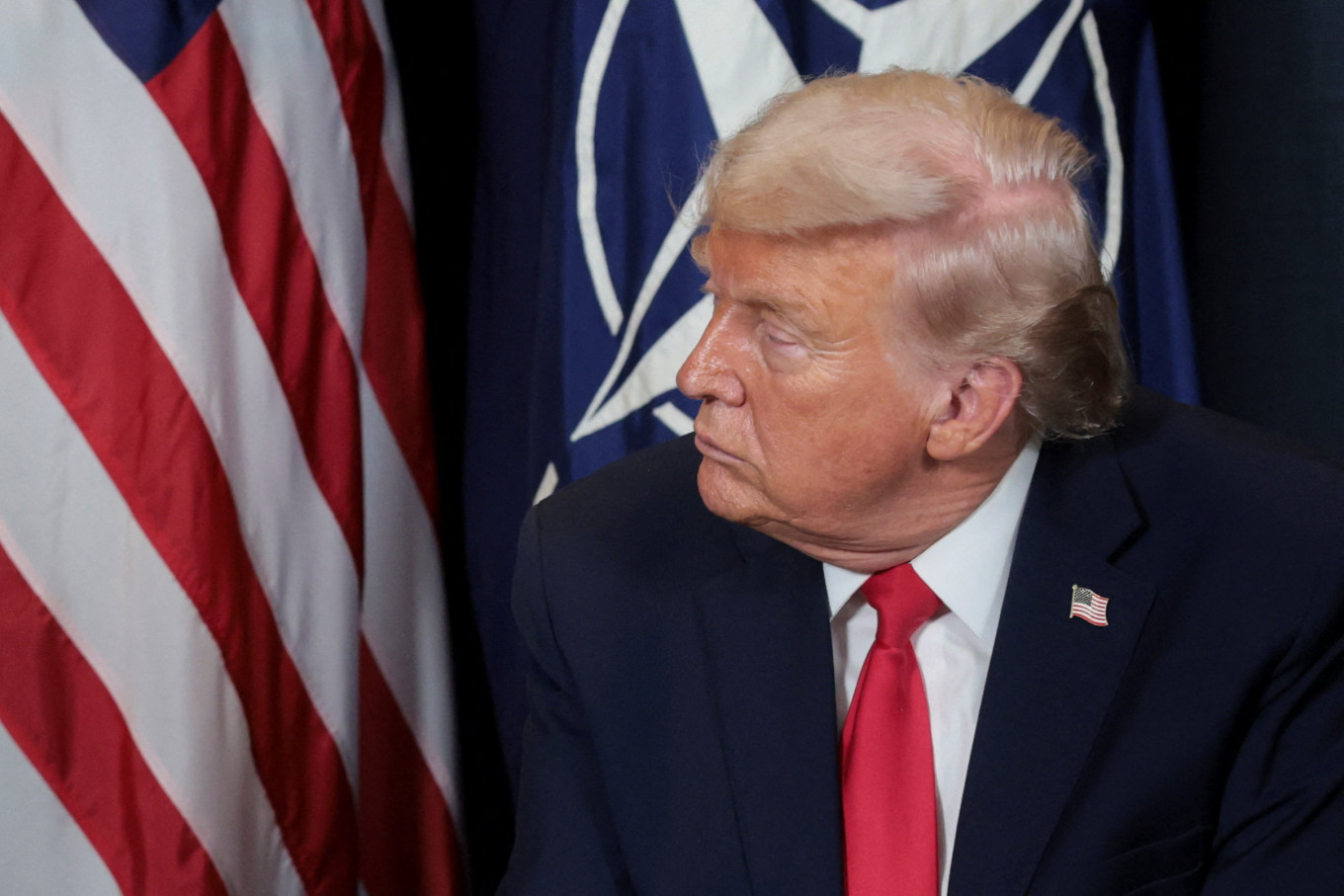 United States President Donald Trump listens during a bilateral meeting with NATO Secretary-General Mark Rutte (not pictured) on Jan. 21 at the World Economic Forum (WEF) in Davos, Switzerland. (Reuters/Jonathan Ernst)
A
s NATO meets in a summit in Ankara, the alliance faces a bigger challenge than either Russia or China: its members no longer share a coherent understanding of the values, economic order, geopolitical vision and legal principles it was created to defend.
Every enduring military alliance ultimately hinges on a deceptively simple question: What is it defending? Without a clear answer, it becomes reactive, defining itself by its adversaries rather than by a common purpose.
When NATO was founded in 1949, that purpose was clear. Emerging from the devastation of World War II, the alliance was established to defend what its founders called the “free world” against Soviet expansionism. More fundamentally, it sought to preserve a liberal international order built on four mutually reinforcing pillars: democratic governance, economic openness, the West’s geopolitical primacy and international law based on the United Nations Charter.
Today, each of these foundations is under strain. Nowhere is this more evident than in the alliance’s political identity, weakened by democratic backsliding and rising authoritarianism. NATO may remain the world’s most powerful military bloc, but its moral legitimacy depends on whether its members continue to embody the democratic values they espouse.
The response of many NATO governments to Israel’s military campaign in Gaza has exposed the widening gap between the alliance’s stated values and its members’ policies. While the International Court of Justice and the International Criminal Court continue to examine allegations of genocide and other grave violations of international law, several leading NATO members — most notably the United States — continue to provide the Israeli government with political support and political cover.
But an alliance whose historical legitimacy is rooted in the postwar rejection of fascism and genocide cannot afford to appear selective in its defense of universal humanitarian principles. Moral consistency is not an ethical luxury; it is a strategic asset that NATO abandons at its peril.

The liberal economic order is also under growing pressure. Ironically, its greatest challenge has come not from NATO’s adversaries but from its own members, as protectionism, tariff wars and the politicization of international trade have undermined the rules-based system that Western countries spent decades building and sustaining after 1945.