The Jakarta Post
Please Update your browser
Your browser is out of date, and may not be compatible with our website. A list of the most popular web browsers can be found below.
Just click on the icons to get to the download page.


Popular Reads
Top Results
No results found. Please check your search term and try again
Can't find what you're looking for?
View all search results
Popular Reads
Top Results
No results found. Please check your search term and try again
Can't find what you're looking for?
View all search resultsbpjs

National 6 years ago
PREMIUM
Poor data denies Indonesia's poorest access to JKN
When the COVID-19 pandemic hit Indonesia in March, South Tangerang, Banten, resident Tinto Arianto Wibowo's 2-year-old son's hospital visits became even more frequent, draining him financially. His son had long suffered fevers, coughing and a lump on his neck and hospitals now suspected him of having COVID-19.



National 6 years ago
Govt officially annuls national health insurance premium hikes in April
The government has officially annulled the increase in National Health Insurance (JKN) premiums following last month’s Supreme Court's ruling that voided Presidential Regulation (Perpres) No. 75/2019 on health insurance.

National 6 years ago
Cut your costs instead, antigraft body tells BPJS
The Corruption Eradication Commission (KPK) says its study of the finances of the Healthcare and Social Security Agency (BPJS Kesehatan), which runs the national health insurance system, shows it could save as much Rp 12.2 trillion (US$833 million) by enforcing better insurance claim management.
National 6 years ago
PREMIUM
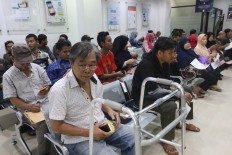
Low premium may mean poorer services in national health insurance
Clients of the national health insurance may rejoice at the Supreme Court’s ruling annulling a sharp increase in the premiums they had to pay, but hospitals say the decision could hurt their already dire financial situation with many bills unpaid.
Opinion 6 years ago
PREMIUM
Building an inclusive, integrated social safety net
While the government’s effort in ramping up the social protection system is worthy of appreciation, top-down integration of the different components is needed in order to optimize the efficiency and effectiveness of the whole program.

Business 6 years ago
Key points of labor reform in omnibus bill on job creation: What we know so far
Some of the key highlights of the bill, a draft of which has been obtained by The Jakarta Post, cover issues related to foreign workers, wages, work hours, redundancy and social security. A one-off extra payment as a “token of appreciation” for workers, which the government calls a “sweetener”, is also introduced in the bill.
Editor's Picks
Popular
- Malaysia must not breathe Indonesia’s governance failure
- Mass poisonings cast doubt on free meals reforms
- New data rules could unlock cross-border data flows
- The state's new muscle
- Jakarta airport and others reopen after volcanic ash crisis
- Anak Krakatau eruption halts flights, schools, fishing
- Barelang Police, Japanese diplomat hold meeting on Batam security
- Soekarno-Hatta airport extends closure after Anak Krakatau eruption
- Travelers scramble as Anak Krakatau ash exposes gaps in contingency plans
- Jakarta international airport extends closure after Anak Krakatau eruption


