The Jakarta Post
Please Update your browser
Your browser is out of date, and may not be compatible with our website. A list of the most popular web browsers can be found below.
Just click on the icons to get to the download page.


Popular Reads
Top Results
No results found. Please check your search term and try again
Can't find what you're looking for?
View all search results
Popular Reads
Top Results
No results found. Please check your search term and try again
Can't find what you're looking for?
View all search resultshomo-sapiens
Society 7 months ago
PREMIUM
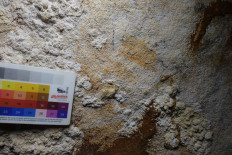
Govt to protect world’s oldest rock art site in Sulawesi
Following the publication of a study on the world’s oldest-dated rock art in Southeast Sulawesi, Culture Minister Fadli Zon said the government would balance the preservation and utilization of the caves where the ancient artwork was found.
Society 7 months ago
PREMIUM
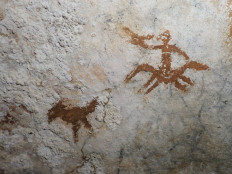
World’s ‘oldest’ rock art discovered in Southeast Sulawesi
The latest rock art found on Muna Island in Southeast Sulawesi, a faded hand stencil made out of ocher that may be made at least 67,800 years ago, might provide more clues for archaeologists about how ancient human migrated through Sulawesi to Australia.

Society 9 months ago
PREMIUM
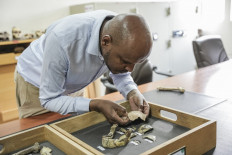
Explainer: Tracing Fadli Zon’s ‘Out of Nusantara’ ancient humans claim
A hypothesis suggesting that ancient humans came from the prehistoric Indonesian archipelago, or Nusantara, is part of a bigger claim that suggests Indonesia as the oldest civilization in the world, Culture Minister Fadli Zon has said.

Society 10 months ago
PREMIUM
Fadli Zon’s ‘Out of Nusantara’ hypothesis meets pushback
Homo sapiens remains found in a cave in West Sumatra are among the proof used by Culture Minister Fadli Zon to support his ‘Out of Nusantara’ hypothesis, which suggests that ancient humans may have originated in the Indonesian archipelago, and not Africa, before spreading around the world.

Art & Culture 1 year ago
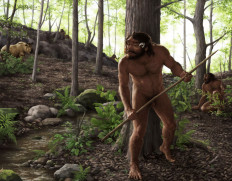
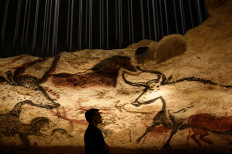
Rarely seen cave art holds prehistoric secrets in France
Discovered in 2000 by an amateur cave explorer, the Grotte de Cussac in the Dordogne department holds ancient human remains, traces of long-extinct bears and stunning, fragile artworks its custodians go to great lengths to preserve.
Science & Tech 1 year ago
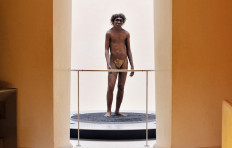
Homo erectus, not sapiens, first humans to survive desert: Study
The moment when the first members of the extended human family called hominins adapted to life in desert or tropical forests marks "a turning point in the history of human survival and expansion in extreme environments."
Editor's Picks
Popular
- Malaysia must not breathe Indonesia’s governance failure
- Mass poisonings cast doubt on free meals reforms
- New data rules could unlock cross-border data flows
- The state's new muscle
- Jakarta airport and others reopen after volcanic ash crisis
- Anak Krakatau eruption halts flights, schools, fishing
- Soekarno-Hatta airport extends closure after Anak Krakatau eruption
- Barelang Police, Japanese diplomat hold meeting on Batam security
- Travelers scramble as Anak Krakatau ash exposes gaps in contingency plans
- Jakarta international airport extends closure after Anak Krakatau eruption


